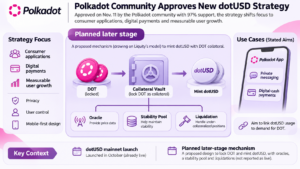
Polkadot’s dotUSD strategy: what the vote approved and what remains planned
Original report: November 15, 2026, 00:02 (UTC+8). Citing an official announcement, PANews reported that the Polkadot community approved…
Original report: November 15, 2026, 00:02 (UTC+8). Citing an official announcement, PANews reported that the Polkadot community approved…

Comparison question: When does a crypto protocol’s buyback create a meaningful link between business revenue and its token—and…
Compare service balances, self-custody, hardware signers, and recovery responsibilities.
Connect proof of work, validation, pool shares, and operating economics without confusing their roles.
Read account behavior without confusing a wallet application, an address, and the authority behind it.
Calculate a hypothetical fee and learn why a reverted transaction can still cost ETH.
Understand head, justified and finalized checkpoints, and why application receipts can arrive before finality.
Learn what deployed code guarantees, what it cannot know, and how upgrades change the trust picture.
Separate allowances, signatures, transfers, and website connections when controlling token access.
Trace who can create units and distinguish a contract supply field from a market-data estimate.
Use unit conversions correctly and avoid mistakes when comparing token balances, prices, and supply.
Compare reserve-backed, collateral-backed, and reflexive designs by tracing redemption and incentives.
Evaluate reserve disclosures without confusing a balance snapshot, an attestation, and a full financial audit.
Understand loan-to-value, liquidation thresholds, interest accrual, and the limits of a collateral buffer.
Explore reserve curves, fee income, inventory changes, and why providing liquidity differs from holding tokens.
Read minimum output and deadlines before a swap, and understand why a successful trade can disappoint.
Evaluate data sources, update rules, freshness checks, and failure behavior in oracle-dependent applications.
Understand lock-and-mint, liquidity routes, message verification, and why a familiar symbol can conceal a new asset.