An analysis by Alea Research, compiled by TechFlow and published on November 11, 2026, compared Robinhood Chain with other Ethereum Layer 2s in the chain’s first full public quarter after mainnet. The like-for-like criteria below are network fee revenue, how much of that revenue came from a short token-launch window, the operator’s fee split, stock-token trading versus NYSE hours, and one same-age product comparison with Coinbase. Network properties, token economics, and reported market behavior are kept separate. Figures are those in the TechFlow compilation; they are not forecasts or return estimates.
Network fees versus other L2s
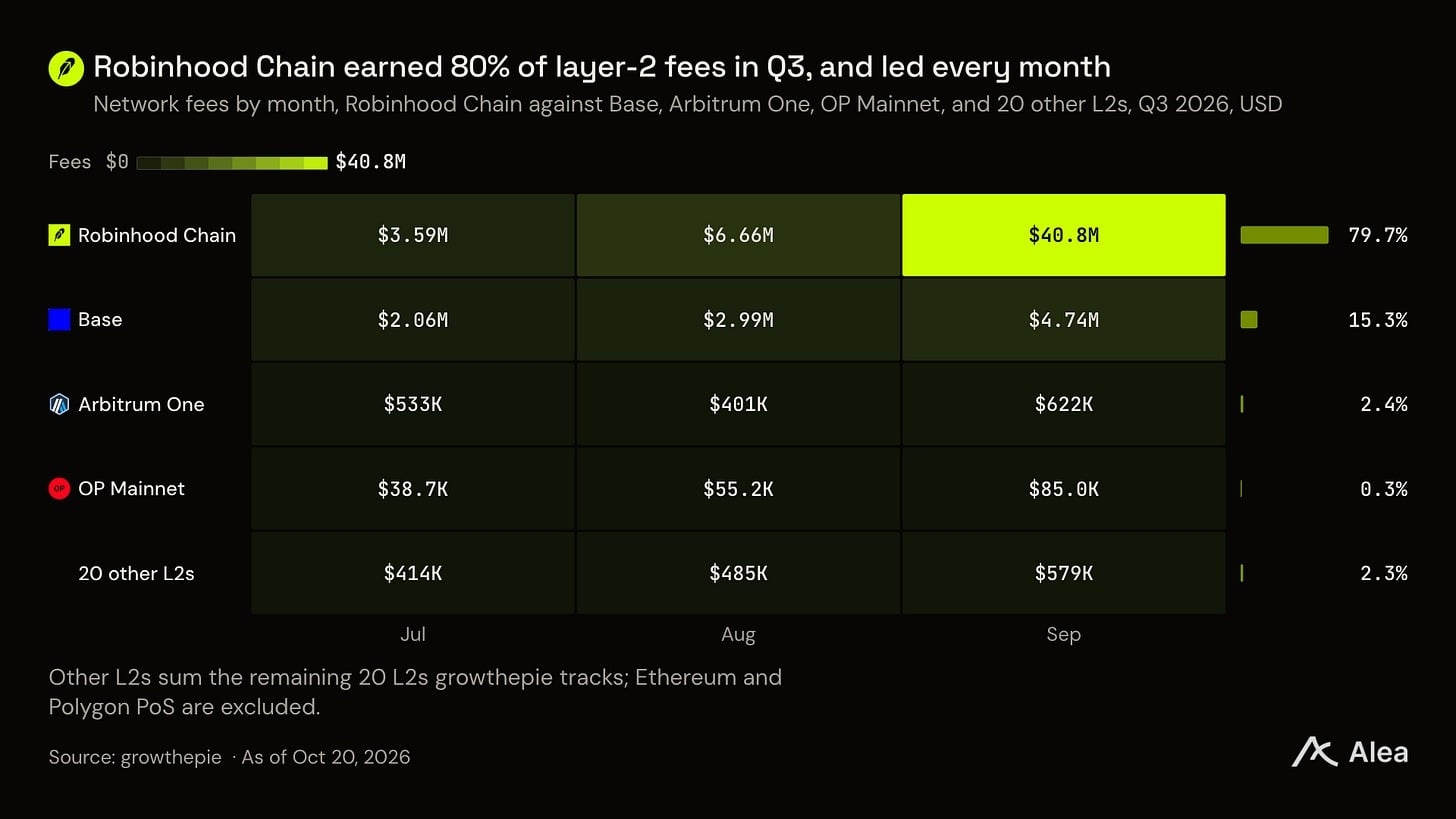
In Q3 2026, Robinhood Chain accounted for about 80% of Ethereum Layer 2 network fee revenue. On-chain exchange volume was $90.7 billion, above the $50 billion in crypto volume matched by the Robinhood app and Bitstamp combined. A token-launch wave supplied 74% of the chain’s fees, while stock tokens’ share of DEX volume rose through the quarter. Monthly fees for Robinhood Chain, Base, Arbitrum One, and OP Mainnet were drawn from growthepie.
Excluding a 12-day launch wave, Robinhood Chain still accounted for 57.7% of all L2 network fees over the other 80 days, versus 30.7% for Coinbase’s Base. In the last week of September, average daily fees had fallen back to the pace recorded from July 1 through August 29.
Reported comparisons from the same quarter:
- With or without the launch wave, Robinhood Chain led L2 network fees. Q3 network fee revenue was $51 million; the median across L2s was $24,700.
- From July to September, stock tokens rose from 2.6% to 15.6% of DEX volume. Before the Monday U.S. cash open, token prices pointed in the correct direction in all 37 weekend or holiday moves of 1% or more.
- At a comparable number of days live, Robinhood Earn’s assets exceeded a Coinbase lending vault. At the start of operating day 92, the Steakhouse vault on Morpho held $499 million, 18% above Coinbase at the same stage.
- On the first fee-share tier, Robinhood’s Q3 network-fee share was $22.9 million, equal to 19% of Robinhood’s $120 million in total crypto business revenue that quarter.
- After the launch wave, gas prices returned to a low range while returning active addresses held up. September returning addresses exceeded Base. Application TVL on the chain reached $1.15 billion on October 22, a high at that date.
Fee split: no native token, tiered operator share
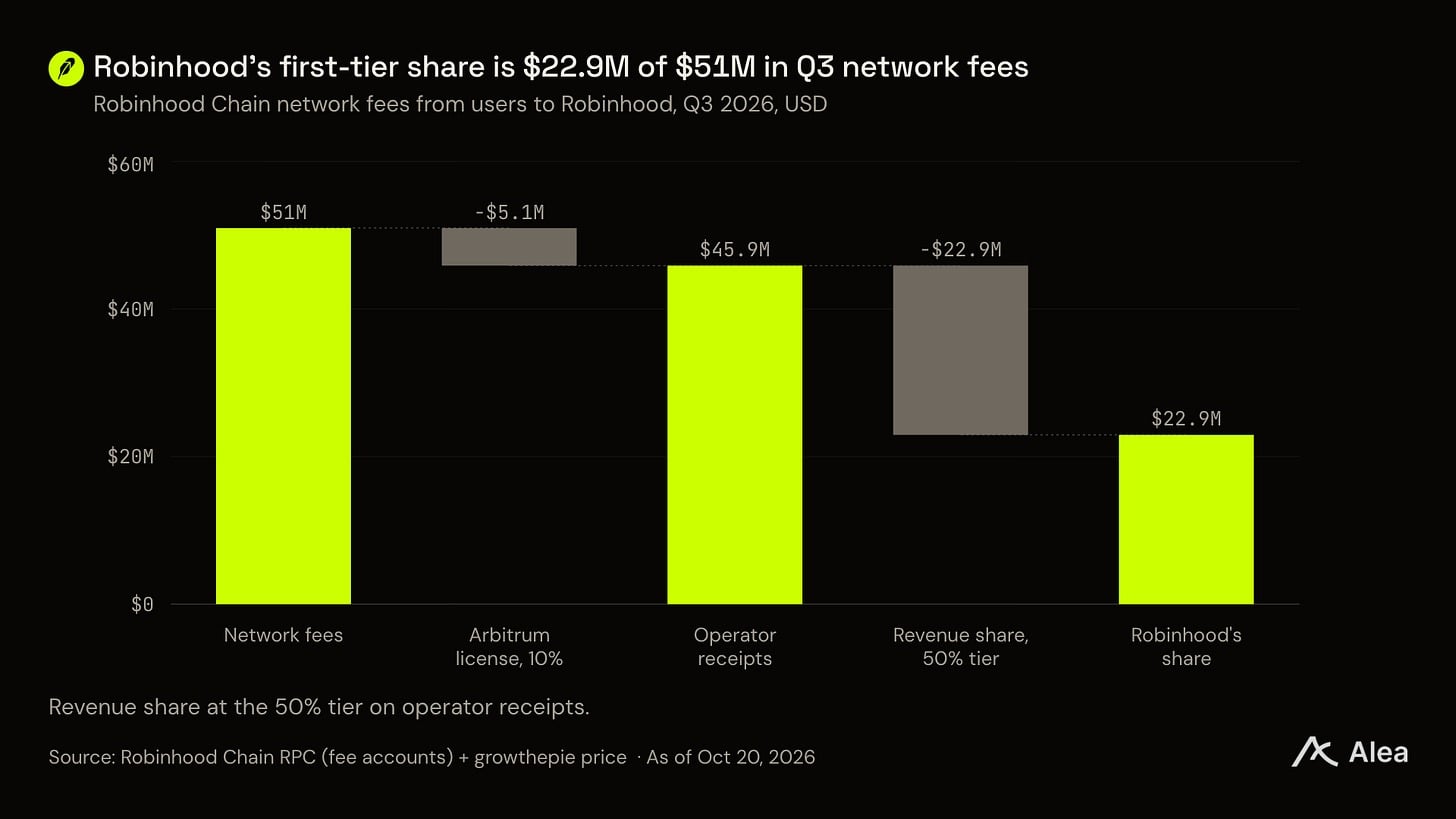
Robinhood Chain is built on the Arbitrum stack and did not issue a native token. As with Coinbase and Base, the operator collects gas, but Robinhood shares a larger portion with ecosystem parties. Arbitrum charges a 10% technology license fee on total network fees.
The remainder is tiered. Until cumulative operating revenue reaches about $50 million, Robinhood keeps 50%. As revenue scales, the retained share steps up to 70% and then 85%. Measured on the first-tier 50% rate, Robinhood’s Q3 share was $22.9 million.
Traders also paid $593 million in application-layer fees in Q3, of which application operators kept $147 million. After a governance proposal passed, the Uniswap protocol fee switch was activated on this chain on July 27. Through September 30 it had funded the buyback and burn of $13.7 million of UNI.
Launch-wave fees versus the rest of the quarter
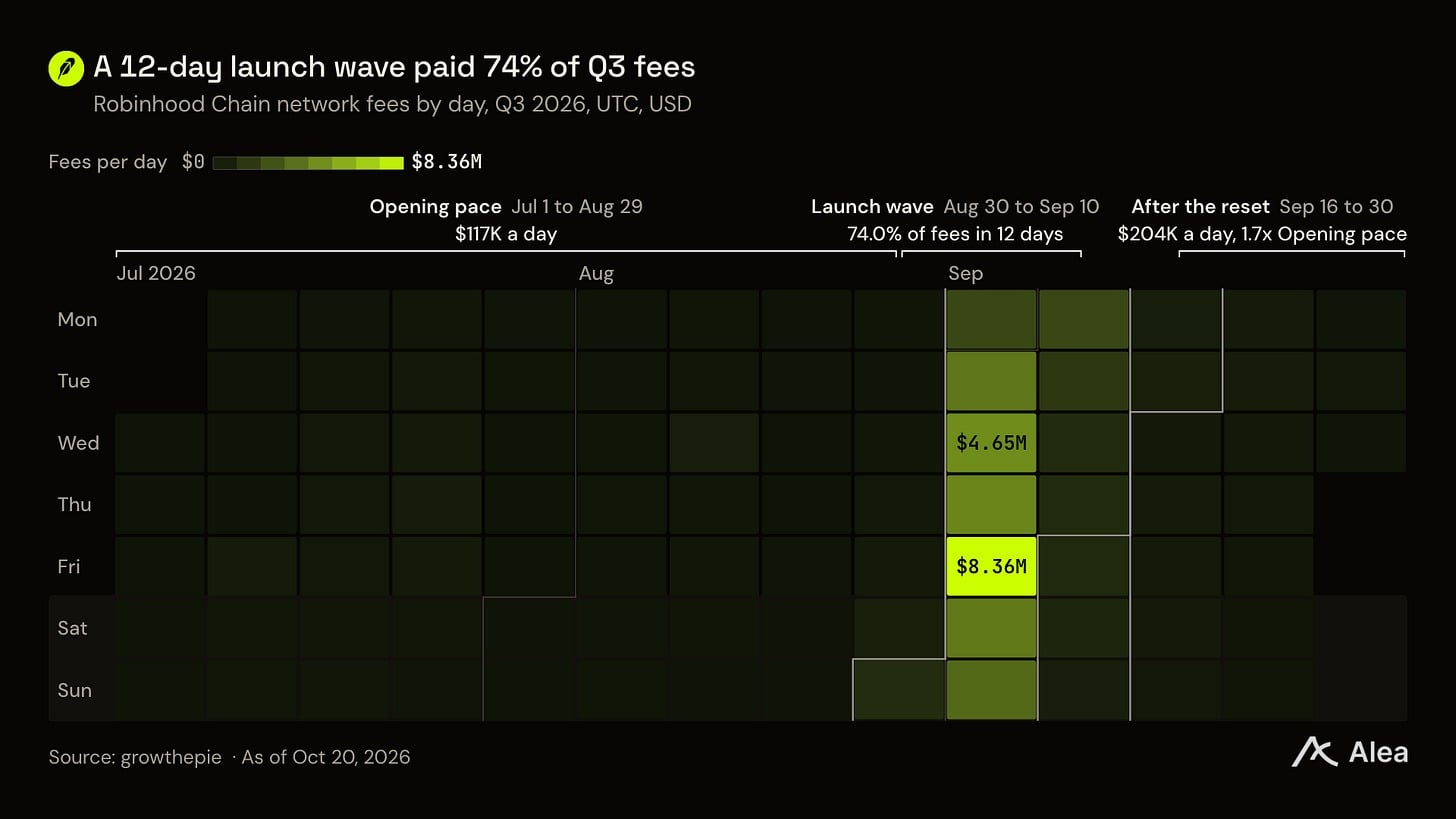
Average gas per transaction in Q3 was 6.4 cents, versus 1.4 cents before the wave. Launch platform Pons shipped a V2 factory contract on August 4 and completed 648,701 token launches. Gas use rose above the preset target, and the base fee climbed with the backlog. From August 30 through September 10, that window produced 74% of quarterly network fees.
The busiest day, September 4, brought $8.36 million in fee revenue, more than double all of July. Versus the prior 12 days, Pons V2 fee revenue rose 7.3 times while pump.fun fell 33% over the same stretch, which the report treats as a Robinhood Chain-specific move.
Within three days Robinhood twice raised the network gas target cap to 40 million gas per second, then lowered it to 15 million on October 18. The analysis states that those capacity settings directly determined most of the chain’s Q3 fee volume.
In the last week of September, average daily fees fell to $121,000 — close to the early post-launch pace in dollars, and 24% lower in ETH terms. From October 1 to 19 the daily average was $54,600, under half the early level, and gas used by the launch platform fell 91%.
Stock tokens when the NYSE is closed
Stock tokens are Robinhood’s tokenized U.S. equities, described as debt instruments fully collateralized 1:1 by the underlying shares and minted only by Robinhood’s Bitstamp. In September, volume in pairs that were not newly issued reached $8.7 billion, above bStocks at $6.4 billion.
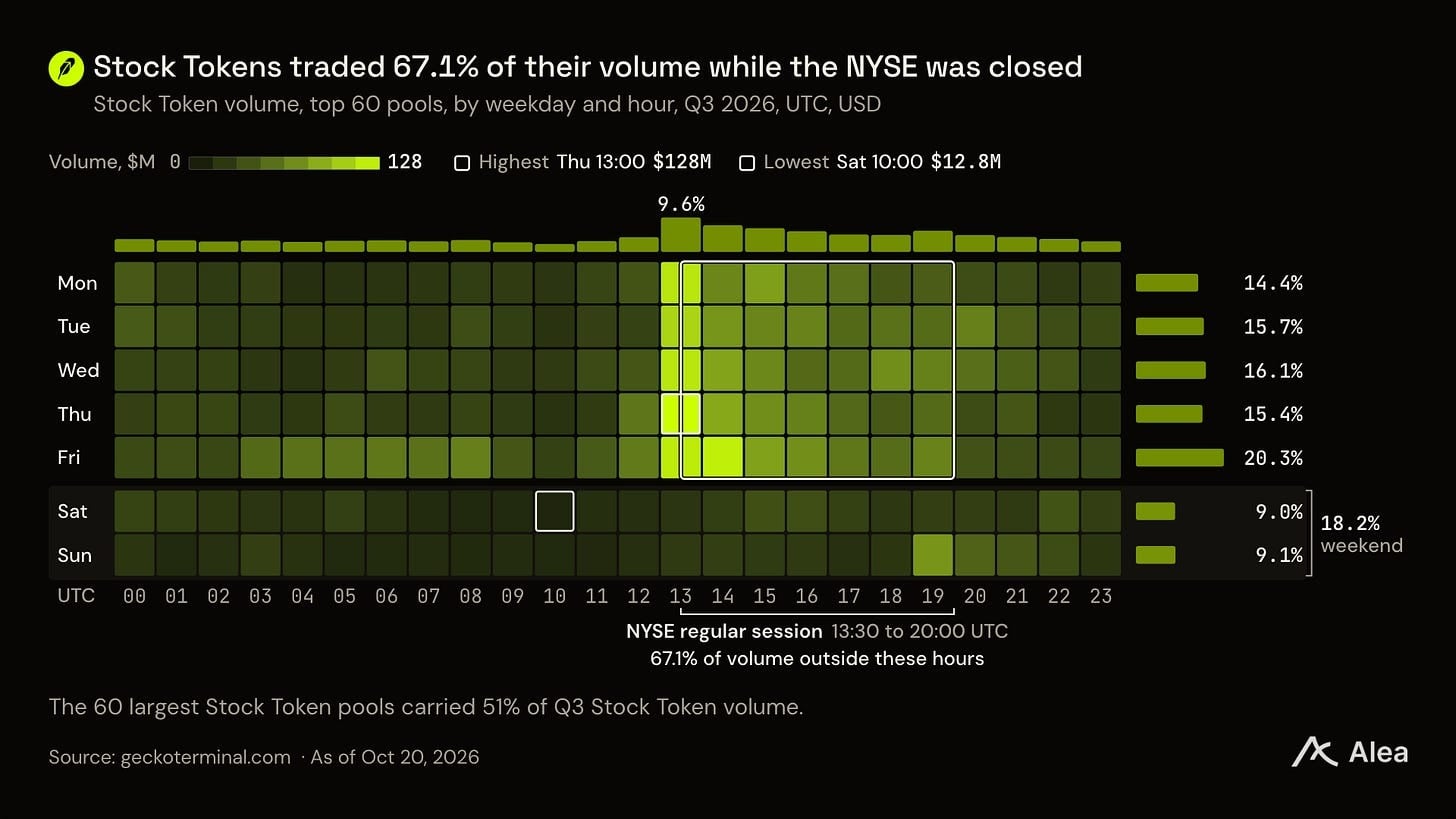
Among the top 60 stock-token pools by volume, 67.1% of Q3 volume occurred while the NYSE was closed. Weekends alone were 18.2%, even though minting and redemption of the underlying shares were closed.
The report says that off-hours trading still produced price discovery. In the 30 minutes before the Monday open, all 37 weekend or holiday gaps of at least 1% were correctly signed by the stock tokens, and the median capture of the move’s size was 86%. At the September NYSE close, the median gap between the ten most active stock tokens and their underlyings was 13 basis points, versus 29 basis points in July.
Robinhood has said it plans to open voting for qualified holders and redemption of tokens for the underlying shares, with no timetable set. A September 17 SEC order allowed compliant U.S. venues to trade tokenized stocks that carry dividends and voting rights — rights the product in place at the time of the report did not have.
Composability widened after the quarter. On October 22, Morpho and Robinhood opened a lending market so holders can post stock tokens as collateral and borrow stablecoins. On October 27, Ondo added 15 tokenized stocks and ETFs; 11 trade in Uniswap pools directly against the corresponding Robinhood stock tokens. Ondo opens cross-chain minting and redemption for those 11 assets each day on Ethereum and BNB Chain, including weekends.
Checkpoints dated after the report’s quarter
In October 27 earnings, Robinhood listed the chain among the top five public chains by revenue and trading volume. The analysis then names three later checkpoints rather than results:
- December 25: at the October pace, the 70% share tier would be reached. After October 26, cumulative operator revenue was $2.9 million short of the about $50 million threshold. Crossing it would give Robinhood a higher share of each new dollar of network fees.
- December 31: the wallet gas subsidy expires. Until then, Robinhood Wallet pays gas in full on swaps above $0.50. January would be the first reading of average daily fee demand without that subsidy.
- Early 2027: subject to regulatory approval, the Robinhood app is planned to offer weekend U.S. equity trading to U.S. users who cannot yet hold stock tokens.
What the quarter separated from the spike
In Q3 2026, no other L2 collected more network fees than Robinhood Chain, whether or not the launch wave is included. The report treats the wave as the source of peak revenue and describes measurable growth in the products underneath it: stock tokens took a larger monthly share of DEX volume and, on the moves studied, indicated Monday’s direction before the opening bell.
Even after October gas revenue had fallen to a low level, $683 million of USDG held against Treasury reserves on the chain was calculated, at Treasury-bill rates, at about $26.9 million a year — stated as about three times Robinhood’s own gas share. If the split later enters the next tier, Robinhood’s share of each additional fee dollar would rise under the published schedule. That reserve figure is a rate calculation in the source, not a forecast of fees, yields, or investment results.
Original article: TechFlow, November 11, 2026.