As reported on Nov. 18, 2026, Russia’s rules allowing retail investors to buy Bitcoin (BTC), Ether (ETH) and Tether’s USDt (USDT) had taken effect two days earlier. The practical question was whether an authorized operator was ready to process those trades—not whether the three assets were eligible under the rules.
The Bank of Russia’s public registry listed 30 authorized crypto exchange operators on Nov. 18, including Sberbank and VTB. But registration alone did not establish that customers could complete transactions. Alexander Nam of HSE University’s Center for Decentralized Finance and Digital Financial Assets Research told Cointelegraph that investor testing, order execution, settlement and custody remained technical or regulatory hurdles. Alexander Brazhnikov of the Russian Association of Cryptocurrency and Blockchain said he could not identify a registered operator offering confirmed retail access as of Nov. 16.
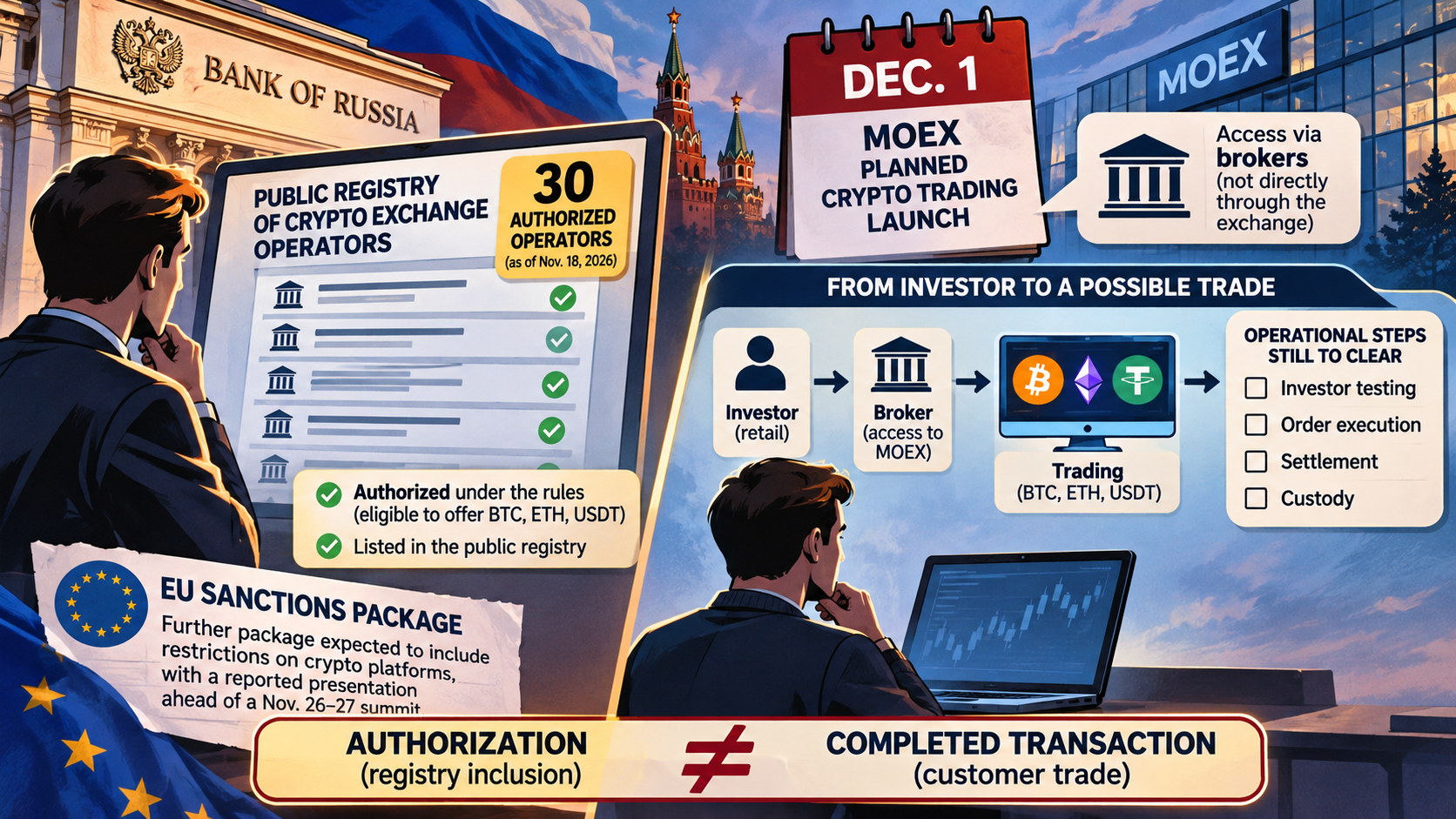
The next scheduled step was separate from the registry. Moscow Exchange (MOEX) planned to launch crypto trading on Dec. 1, with investors accessing it through brokers rather than directly through the exchange. Cointelegraph said VTB, T-Invest Lab and MOEX had not responded to its questions about launch plans by publication time.
Sanctions were another uncertainty, not a restriction already imposed by the reported EU package. A person familiar with the regulatory discussions told Cointelegraph that some companies feared a public registry could make them sanctions targets. The same source said industry representatives had asked the central bank to keep the registry private, but it refused. The European Union was preparing a further sanctions package expected to include restrictions on crypto platforms; its reported presentation was planned ahead of a Nov. 26–27 summit.