
As reported on November 6, 2026, Ethereum core developers had delayed the Glamsterdam upgrade on the Hoodi testnet. The Ethereum Foundation said the fork would not proceed until security concerns involving eight smart contract invariants were resolved.
The concern is how existing contracts handle gas costs. In an October 13 report, auditor ChainSecurity found that Glamsterdam’s EIP-8037 and EIP-8038 could break contracts that assume certain operations have fixed gas costs when external calls fail. The Ethereum Foundation said the proposals change how gas is charged for some operations, potentially invalidating assumptions used by existing projects. The delay gives developers time to identify affected contracts and determine whether changes are needed before the upgrade progresses toward mainnet.
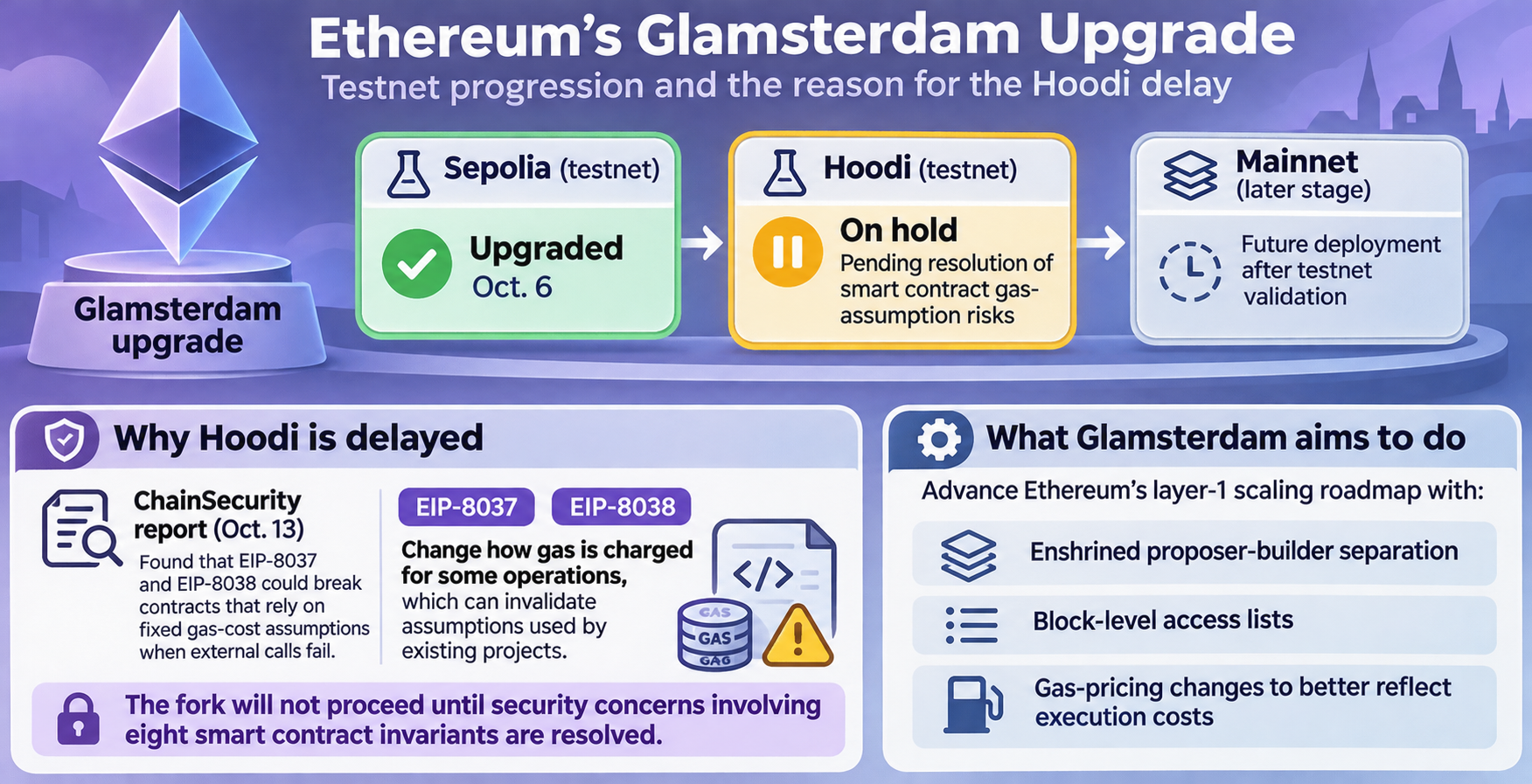
Sepolia and Hoodi were at different stages: Glamsterdam had gone live on the Sepolia testnet on October 6, but its Hoodi fork remained on hold. The broader upgrade aims to advance Ethereum’s layer-1 scaling roadmap through enshrined proposer-builder separation, block-level access lists and gas-pricing changes intended to better reflect execution costs. The reported delay concerned testing those changes safely; it was not a mainnet deployment.