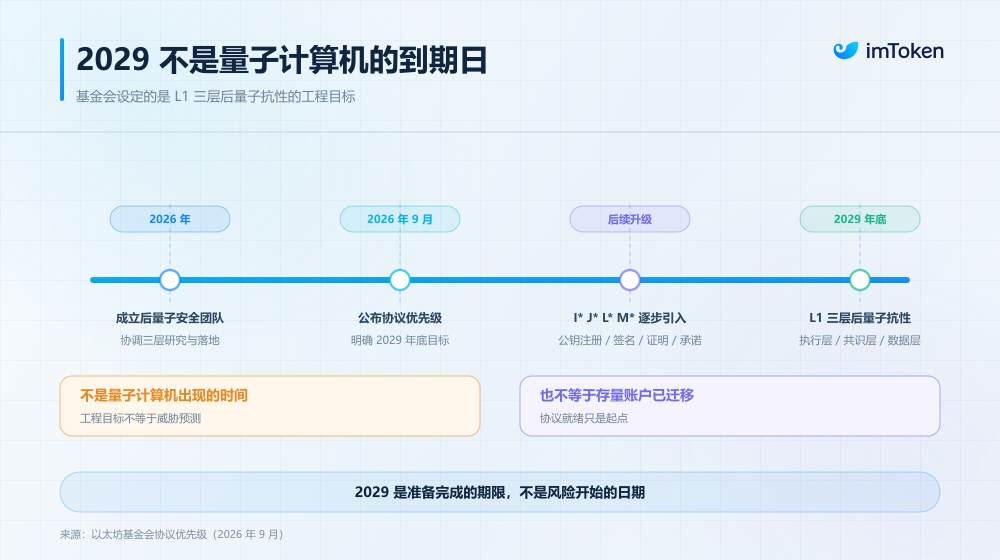
As reported on November 19, 2026, Ethereum’s post-quantum work was a proposed, multi-year security transition—not a response to a quantum computer already capable of breaking its cryptography. imToken reported that protocol priorities published in September 2026 set a goal of making Ethereum L1 resistant to quantum attacks across its execution, consensus and data layers by December 2029.
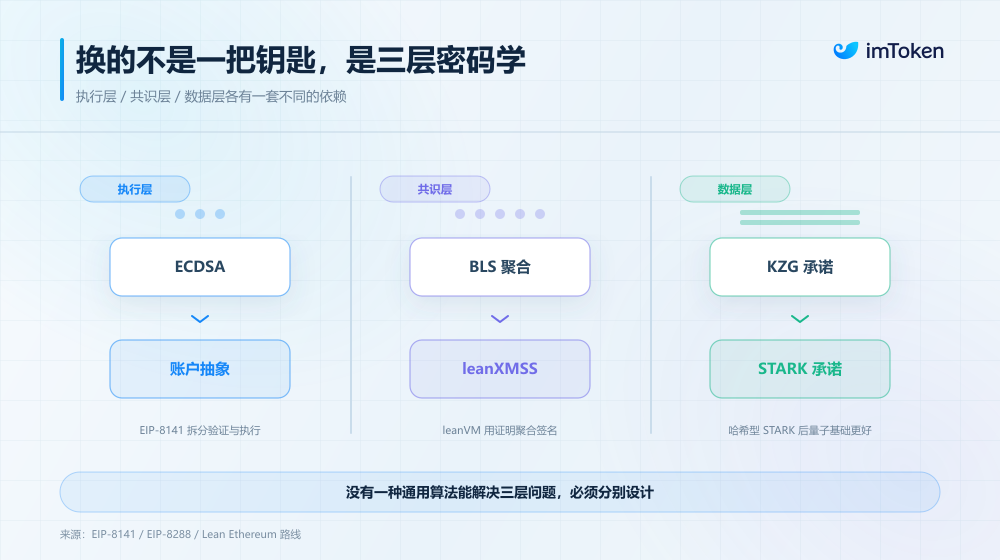
The comparison that matters is which cryptographic job each layer performs. Replacing a wallet signature does not, by itself, replace validator signatures or the commitments used for data availability.
Accounts: changing keys without abandoning an identity
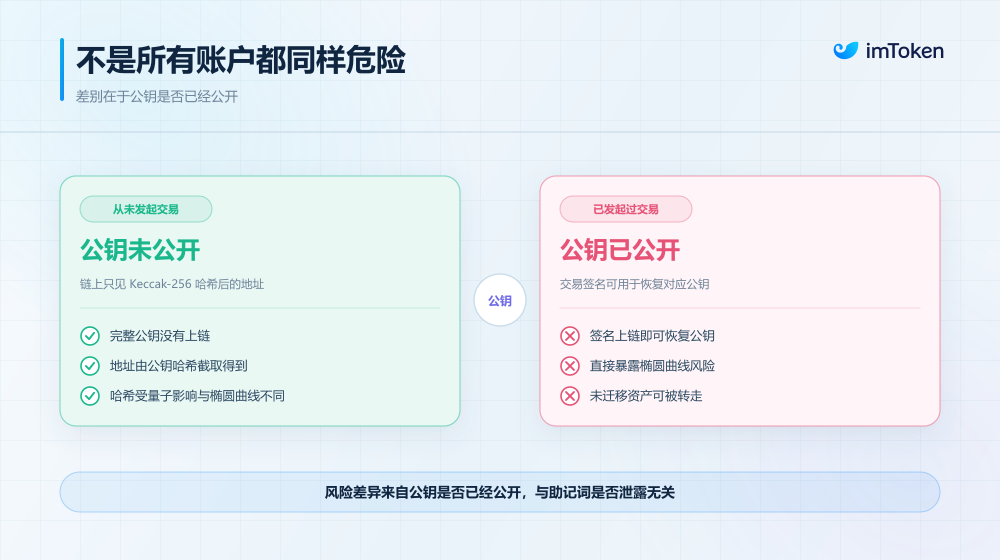
Ordinary Ethereum externally owned accounts use ECDSA signatures. A sufficiently capable fault-tolerant quantum computer running Shor’s algorithm could, in theory, undermine the elliptic-curve assumptions behind that system. The risk also depends on what an account has revealed: an address derived from a hashed public key does not itself expose the full public key, while a transaction signature makes the public key recoverable. A wallet that has never transacted or disclosed an off-chain signature therefore differs from one that has.
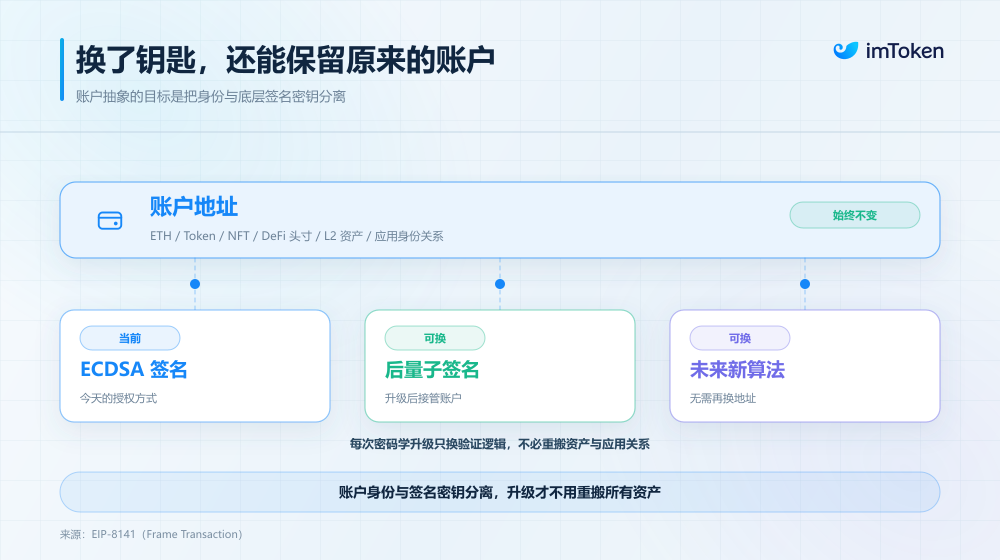
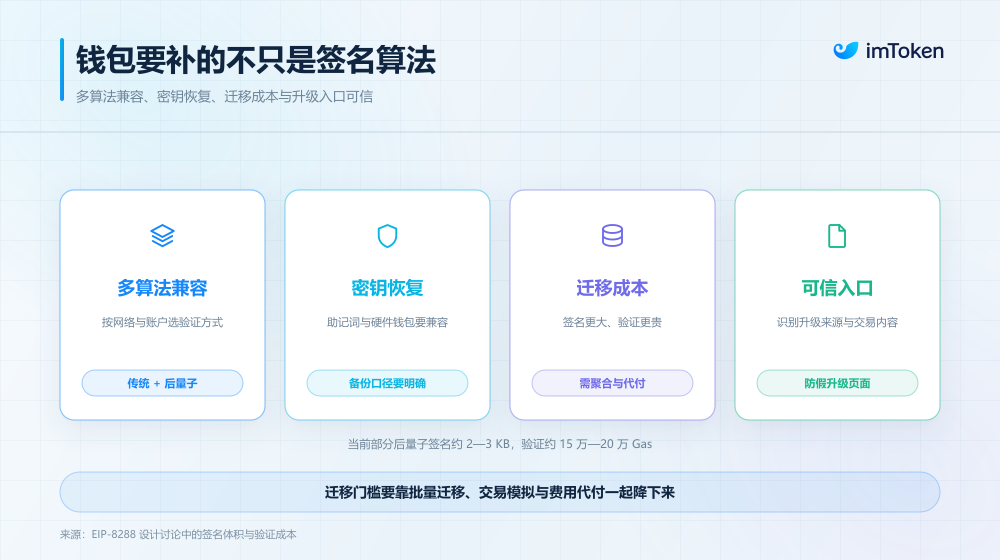
For users, the migration problem is not just generating a new key. Moving to a new address could require dealing with tokens, NFTs, DeFi positions, L2 assets and application permissions tied to the old address. EIP-8141 is an account-abstraction proposal intended to make transaction validation programmable, leaving room for key rotation and different signature checks. It is a proposed path toward retaining account identity while changing authorization—not a migration capability users can assume is already in place. The source also describes research into post-quantum signature-verification precompiles and EIP-8288’s proposal to use recursive STARK aggregation to reduce verification burdens.
Validators: replacing aggregation as well as signatures
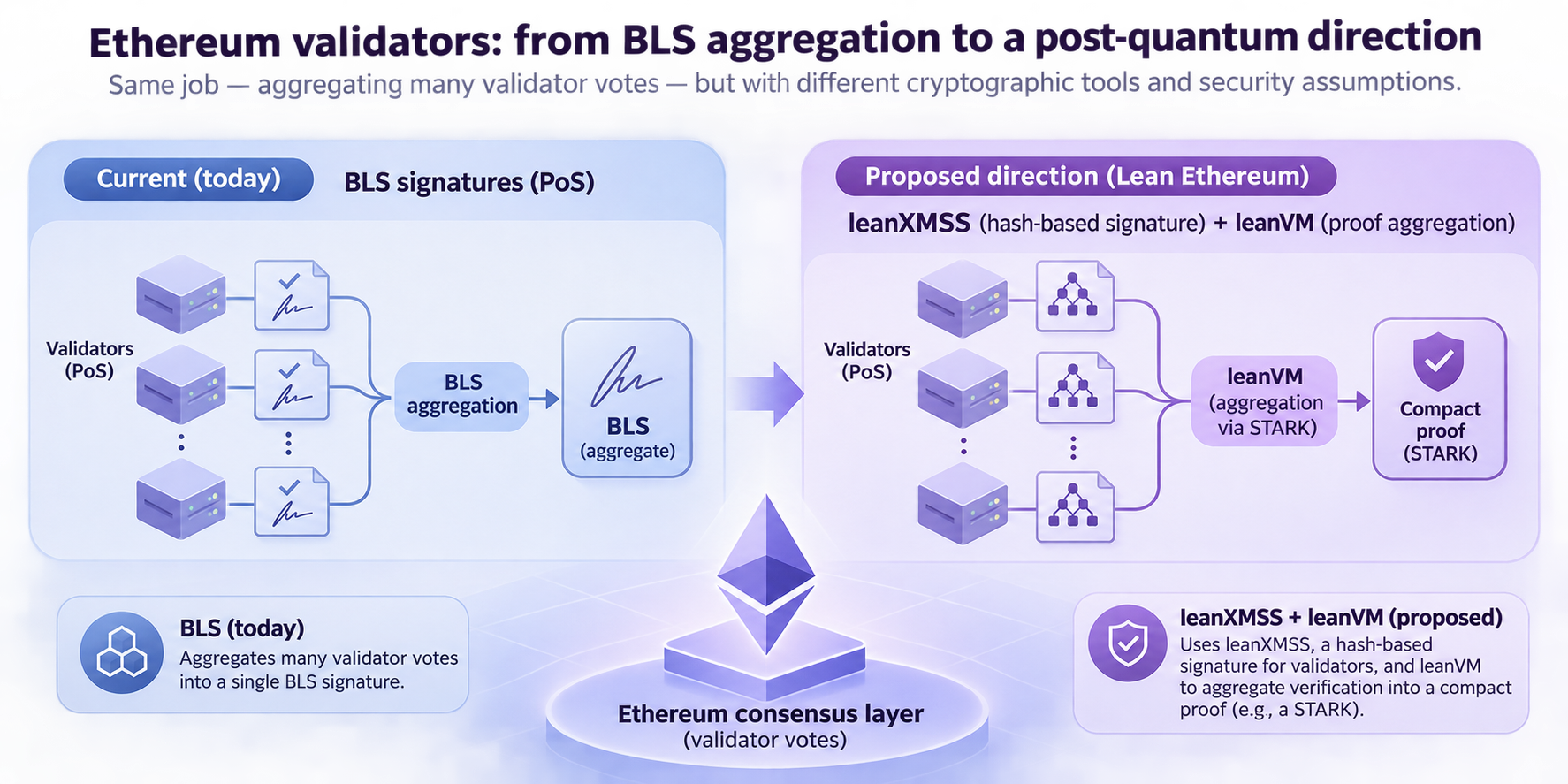
Ethereum’s proof-of-stake consensus uses BLS signatures, whose aggregation helps handle validator votes. Simply substituting larger post-quantum signatures could raise network, storage and verification costs. The Lean Ethereum directions described by imToken pair leanXMSS, a hash-based signature approach proposed for validators, with leanVM, intended to aggregate verification into compact proofs. These address a different operational requirement from a user account’s ability to change its controlling key.
Data and proofs: a separate set of assumptions
KZG commitments used with blobs and rollup data availability also depend on elliptic-curve-related assumptions. Some pairing-based SNARKs face a similar long-term issue; hash-based STARKs do not rely on the same elliptic-curve discrete-log assumption. That distinction does not mean every rollup or application has already migrated. imToken’s account presents L2 and application changes as part of the longer-term work beyond L1.
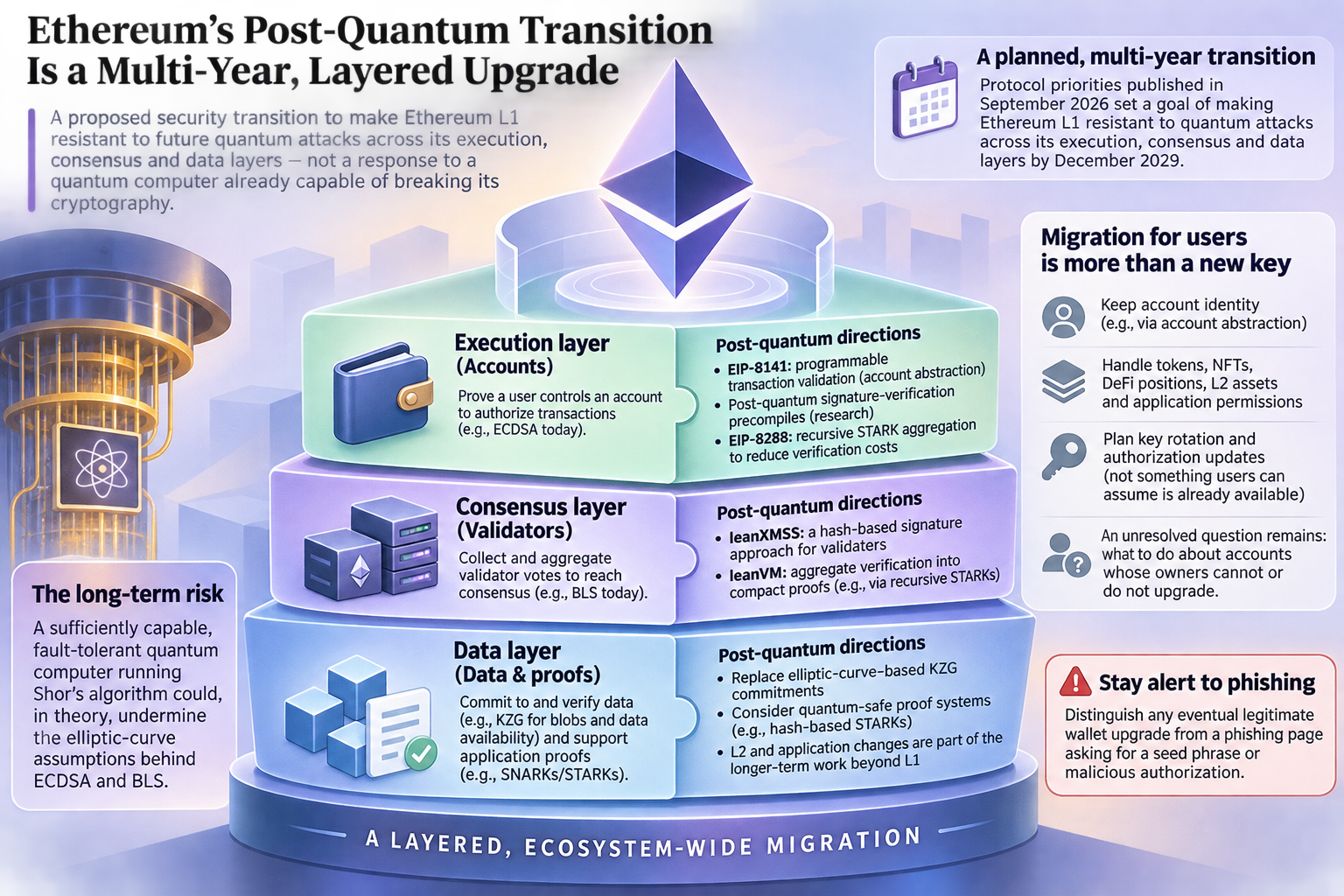
At the time of the November 2026 report, imToken said no quantum computer had demonstrated the ability to break the cryptography at issue. It also identified an unresolved migration question: what to do about accounts whose owners cannot or do not upgrade. Its practical warning was to distinguish any eventual legitimate wallet upgrade from a phishing page asking for a seed phrase or malicious authorization. The December 2029 date was an engineering target, not a claim that these mechanisms had already been deployed.