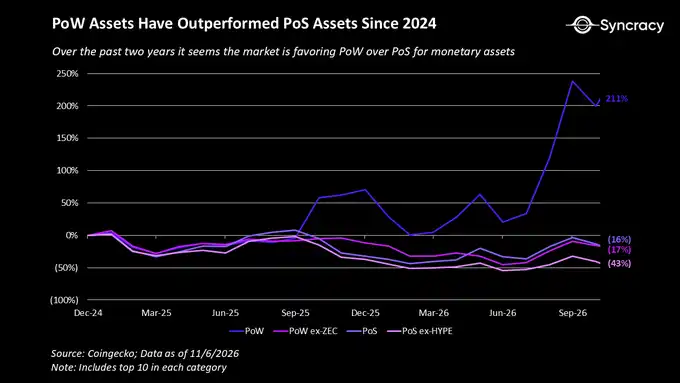
As reported on November 19, 2026, crypto investment firm Syncracy had built a substantial PEARL position over the preceding two quarters. Its thesis was that AI inference providers could earn mining rewards while performing work customers already pay for. The comparison with Bitcoin turns on a specific question: can useful AI computation support a durable proof-of-work security budget? Syncracy’s forecasts are investment claims, not established outcomes.
What pays for the work?
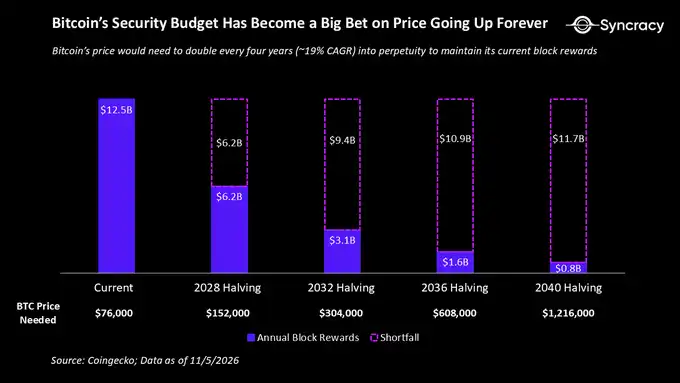
Bitcoin miners rely on block subsidies and transaction fees. Its subsidy halves roughly every four years. Syncracy calculated that, if fees do not make up the difference, Bitcoin’s price would need to double every four years—about 19% compounded annually—to keep the subsidy’s dollar value unchanged. That calculation is not a forecast of Bitcoin’s price.
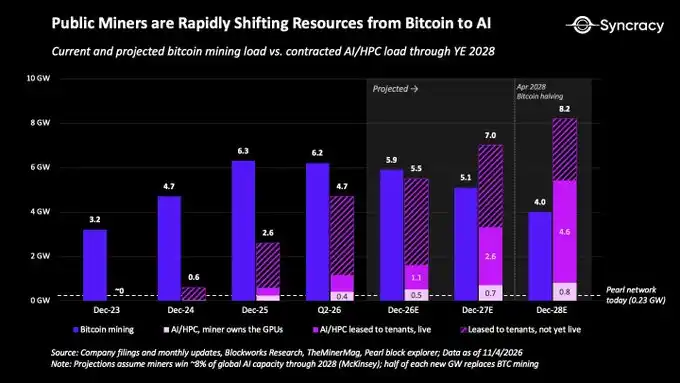
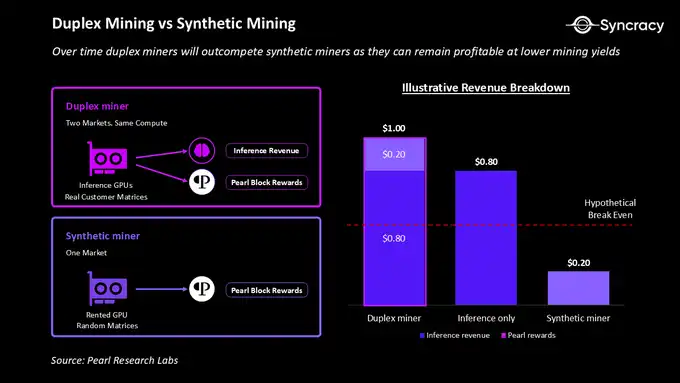
Pearl takes a different approach. Its proposed advantage is to make matrix multiplication used in AI inference also produce proof-of-work. A provider serving paying inference customers could then receive both service revenue and PEARL mining rewards from the same workload. By contrast, a miner running calculations solely for PEARL rewards has no inference customer covering those costs.
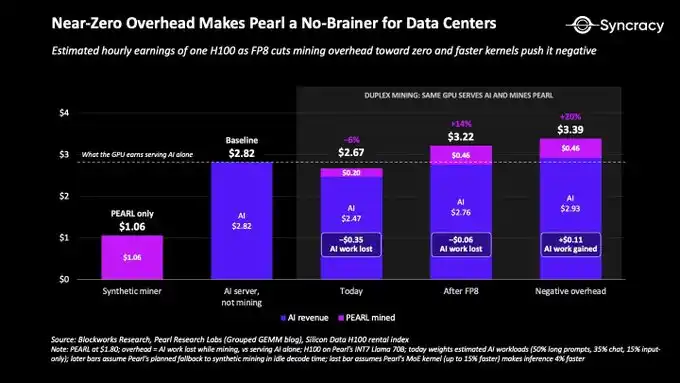
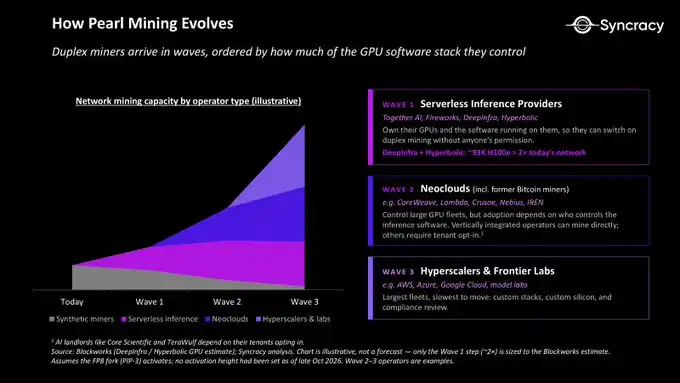
Syncracy said Pearl mining currently adds about 5% overhead and that a planned FP8 upgrade could reduce it to near zero. Based on its discussions with miners, it estimated that roughly 80% of Pearl mining was still performed on consumer GPUs. The upgrade’s effect—and whether inference providers adopt it at scale—remained unproven. Together AI had launched an inference service that mines PEARL while handling customer requests and uses the mined tokens to subsidize inference prices; that product does not establish network-wide adoption.
What does the comparison leave out?
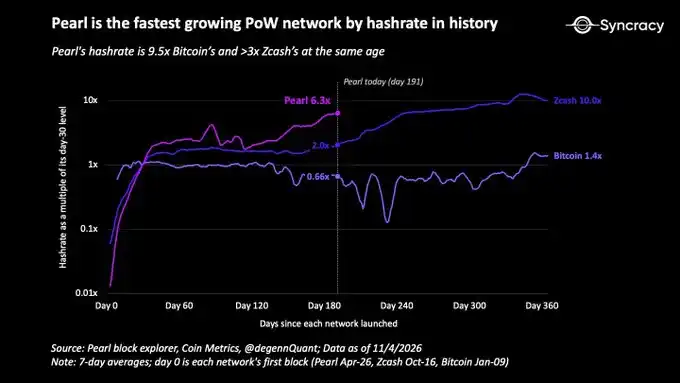
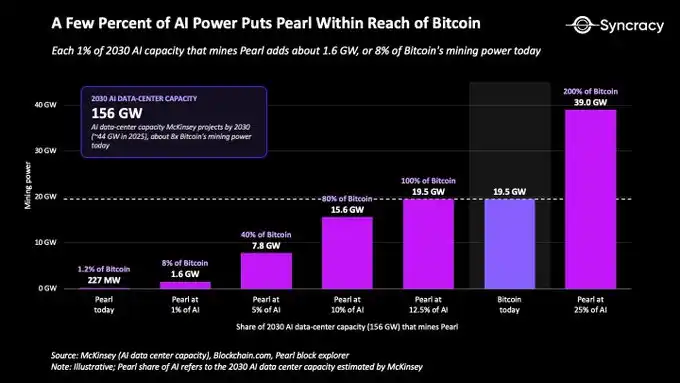
Syncracy suggested that Pearl could draw on more computing and energy resources than Bitcoin before 2030. The networks perform different calculations, however, so their raw hash-rate figures cannot be compared directly. Resources committed to mining are not, by themselves, a complete measure of security: GPU hardware can be redirected to other uses, while Bitcoin’s specialized mining hardware is more dependent on Bitcoin. Syncracy acknowledged that this difference could affect an attacker’s economic cost.
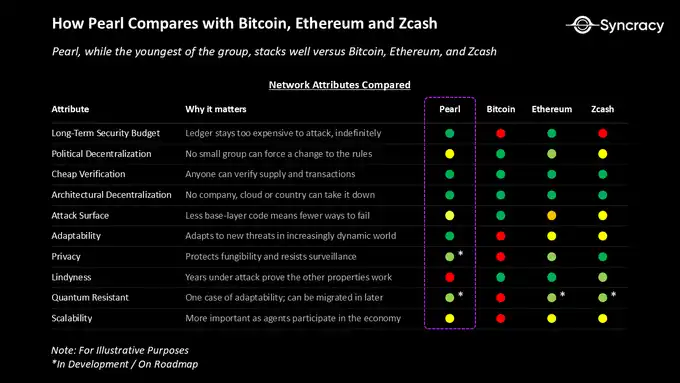
There is also a stability trade-off. Syncracy said Pearl had undergone four forks since April and planned another to support FP8. Keeping mining compatible with changing AI formats may require further protocol updates, whereas Bitcoin’s mining algorithm does not depend on AI formats. Syncracy said Pearl had quantum-resistant support on mainnet, while native privacy remained in development and a forward market for computing power was only a possible future use. Neither was an existing source of token demand described in the report.
The clearest test of Syncracy’s thesis is not a projected date when Pearl might surpass Bitcoin. It is how much Pearl mining, after the planned upgrade, actually comes from paid AI inference rather than mining-only workloads—and whether those providers continue contributing resources when PEARL rewards fall.