In a market review published on November 24, 2026, XRP, Monero (XMR) and Dogecoin (DOGE) showed different combinations of price movement, trading activity and network use. Those measures are not interchangeable: a price bounce does not, by itself, establish a recovery in network activity.
XRP: More reported payments, weaker trading activity
The review said XRP’s average daily payments in November had exceeded 1.1 million, up 107% from its October baseline. It also reported more than 1.33 million transactions during the first seven days of November and, citing an XRPScan query from November 23, said 4,065 new accounts had appeared over a rolling 24-hour period. These figures describe different measures and time windows.
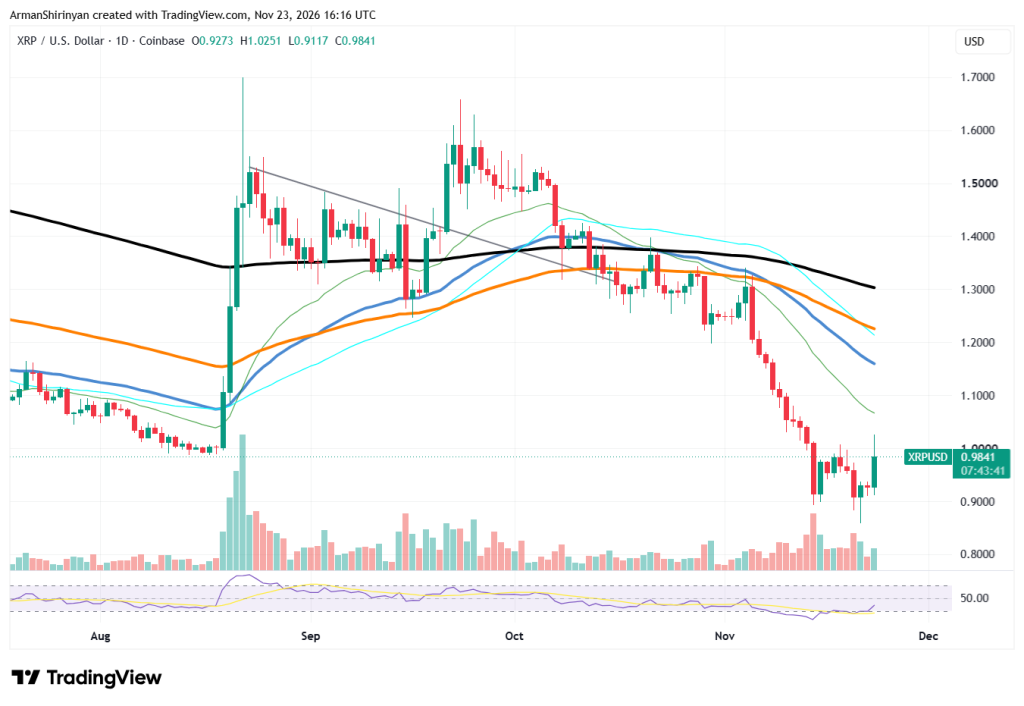
XRP was trading near $0.99, about 23% below its 30-day average, while spot trading activity had fallen roughly 22.5% during the month, according to the review. It identified $0.90 as a local support level and $0.99, $1.00 and $1.04 as levels to watch—not confirmed recovery milestones.
Monero: A price gain with limited evidence of stronger network use
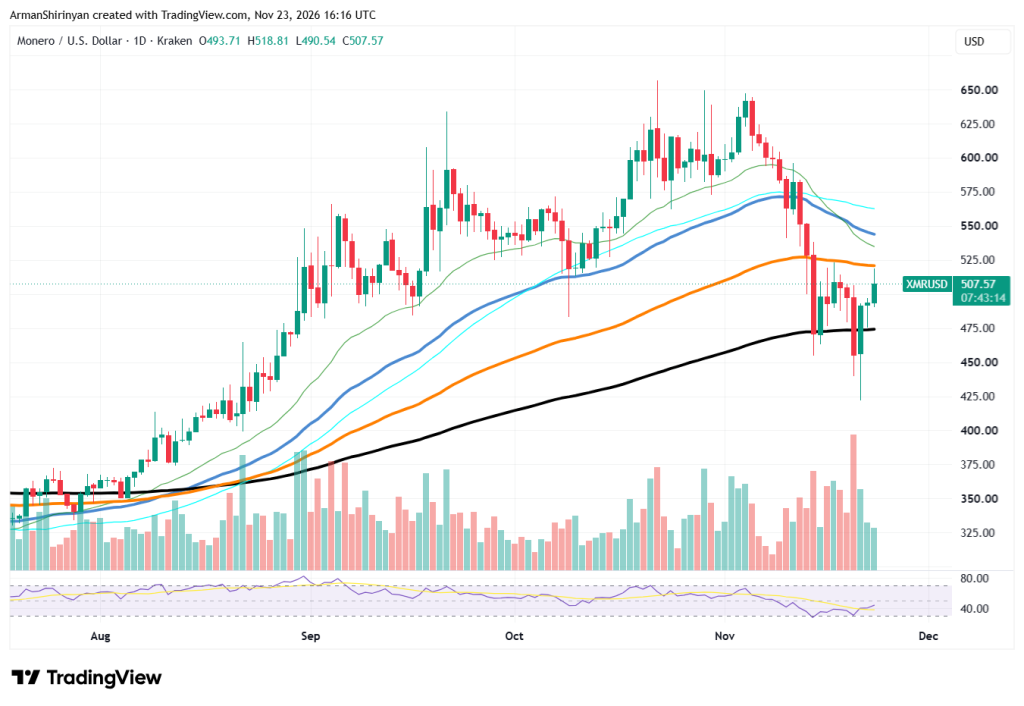
Citing CoinMarketCap, the review put XMR’s 24-hour gain at more than 4.7% and said futures open interest had passed $230 million. It also said Monero’s transaction count was below its 30-day average. Because Monero protects transaction details, its network activity is harder to assess comprehensively; the reported price gain alone does not demonstrate increased privacy demand.
The review linked selling pressure to an incident involving Wrapped Monero, reporting that the wrapped token lost more than 99% of its value and caused $13 million in losses. That token is distinct from Monero’s main network. Separately, it said a November 18 audit of the main network found no high- or medium-severity vulnerabilities and identified minor issues that were reported to developers. The review placed XMR’s nearby price levels at $500 for support and $508–$510 for a breakout area.
Dogecoin: A recovery attempt amid lower activity
Citing CoinGlass, the review reported $584 million in DOGE futures volume and $86 million in spot volume, with both volumes declining and open interest rising slightly. It said 37,000 addresses had been active in the preceding 24 hours, down 24% year to date. Explorer data cited in the review showed that the ten largest DOGE addresses held more than 44% of available supply. Addresses are not the same as individual owners, so that figure does not establish that ten users control those holdings.
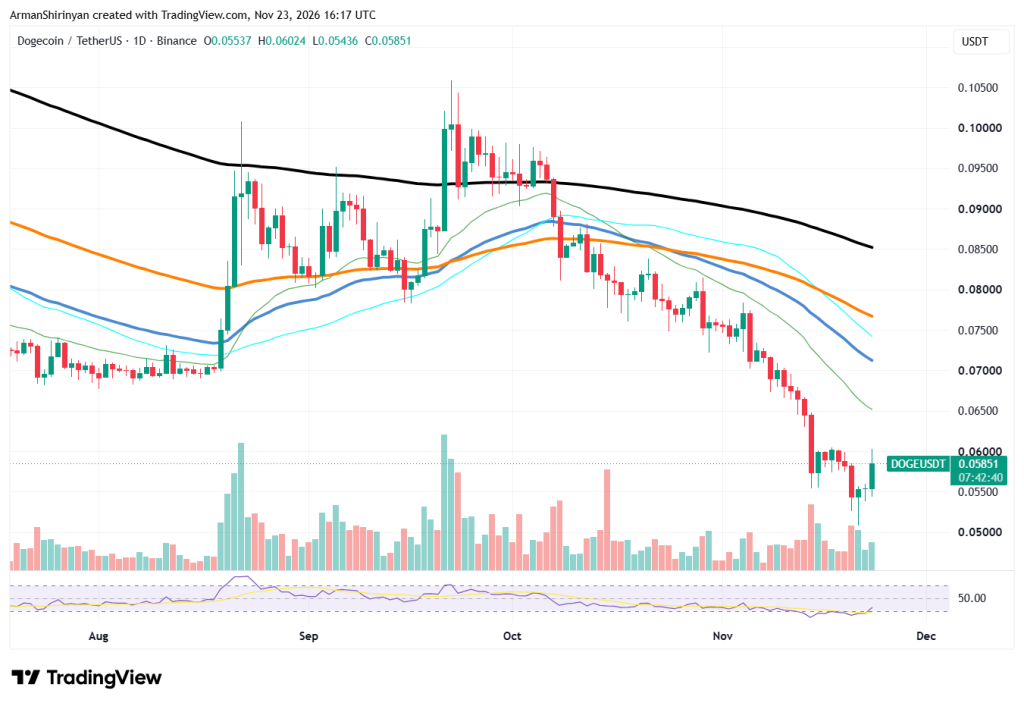
The review identified $0.054 and $0.05 as support levels, and approximately $0.0599–$0.06 as resistance and a proposed trend-recovery threshold. With trading activity declining, these chart levels are observations rather than evidence that a recovery will occur.