Bitcoin’s realized losses nearly doubled in a week relative to the money that flowed into Bitcoin over the previous year, Glassnode said on November 24, 2026. The measure reached its highest level since FTX collapsed in November 2022. Glassnode called it the first major capitulation of the current bear market, but comparable readings have not reliably marked a price low.
Bitcoin was more than 50% below its October 2025 peak. It traded near $60,242 early on November 24, down 1.57% over 24 hours, before slipping to $59,992 later that day.
What the loss measure captures
Glassnode counts a realized loss when a coin moves on-chain at a lower price than when it last moved. Comparing those losses with a year of inflows, rather than comparing dollar losses alone, gives the firm a common basis for assessing sell-offs across market cycles.
From mid-April to mid-November, most realized losses came from coins held for roughly five months or longer. These long-term holders typically sell less often. By November 24, their share of losses had fallen to about half as newer buyers also began taking substantial losses.
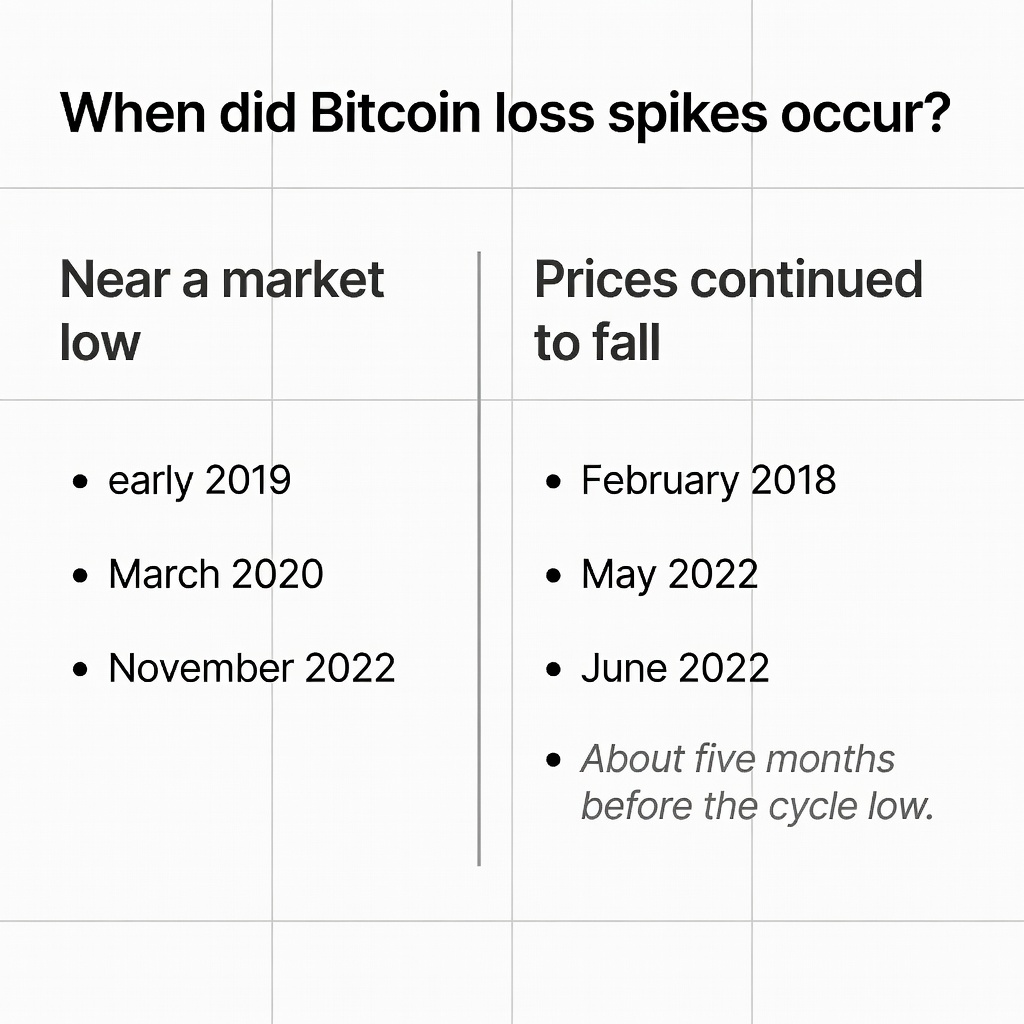
In past downturns, long-term holders accounted for most losses for months before Bitcoin bottomed. The timing of loss spikes was less consistent: those in early 2019, March 2020 and November 2022 came near market lows, but prices continued to fall after spikes in February 2018 and in May and June 2022. The June 2022 sell-off preceded the cycle low by about five months.
U.S. demand: ETF withdrawals and Coinbase selling
U.S. spot Bitcoin ETFs recorded $4.3 billion in net withdrawals over 20 trading days. Exchange activity also differed by venue: over 30 days, traders placing orders for immediate execution on Coinbase were heavy net sellers, while buying and selling on Binance were roughly balanced. Glassnode identified a return to ETF inflows and net buying on Coinbase as early signs to watch for a recovery in U.S. demand.
Bitcoin’s correlation with the Nasdaq 100 was at its highest since September 2022, but the two did not move equally. Over 60 trading days, Bitcoin gained less when the index rose and lost more when it fell. On November 23, after Nvidia said Jensen Huang was returning as CEO, Bitcoin rose 5% in about half an hour. It gave up the entire gain less than six hours later, while the Nasdaq 100 retained about three-quarters of its own advance.
Closing prices versus intraday lows
Bitcoin closed below the $62,000–$66,000 range on November 19 and traded as low as $55,300 on November 21. For Glassnode’s comparison with June, however, the relevant figure was the daily close. The sell-off’s lowest close, on November 20, remained just above June’s closing low of $58,500.
Glassnode said a decisive break below $60,000 followed by a close under $58,500 could bring $53,200 into view. That was Bitcoin’s realized price—the estimated average price at which coins last moved on-chain—and was about 11% below $60,000. Bitcoin traded below its realized price before bottoming in each of the previous three major bear markets. Applying the discounts recorded at the 2022 and 2018 lows would imply prices near $41,000 and $37,000, respectively. Those are historical comparisons, not forecasts.
Leveraged positions, options and mining revenue
The decline passed through a concentration of leveraged long positions between $55,000 and $62,000. Nearly 90% of the longs Glassnode’s model had tracked a week earlier between the market price and the realized price were gone, leaving fewer positions exposed to forced selling above the realized price. Another cluster remained near $51,500.
In options, the seven-day average reached 1.7 puts traded for every call, the highest ratio since June 2022. Between $58,000 and $64,000, dealer hedging could amplify moves in either direction: dealers in that range tend to sell as prices fall and buy as they rise.
Bitcoin’s hash rate fell 8% year over year, its first annual decline since China’s 2021 mining ban. Luxor’s Hashrate Index put daily mining revenue at $29.36 per petahash per second on November 23, down from $30.27 a week earlier.