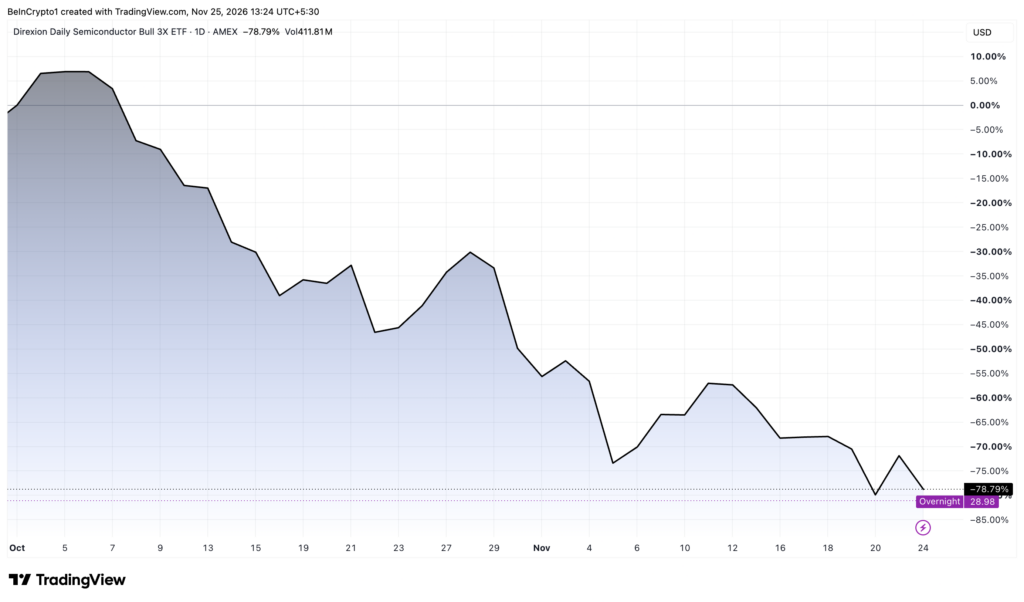
Perpetual futures on SOXL, a leveraged semiconductor fund, recorded about $85 billion in trading volume on crypto exchanges in October 2026, according to WuBlockchain data cited in a report published on November 25, 2026, at 23:00 (UTC+8). That put SOXL ahead of contracts tied to any individual stock. By the morning of November 25, the SOXL contract had fallen about 32% in 24 hours, and long positions accounted for most liquidations.
How the fund differs from the futures contract
SOXL, the Direxion Daily Semiconductor Bull 3X Shares, aims to deliver three times the daily move of a semiconductor stock index. A SOXL perpetual is a separate contract on the fund’s price. It trades around the clock without an expiry date. A trader who uses leverage on the contract adds a second layer of exposure to the fund’s already amplified daily moves.
CryptoQuant had tracked a rise in equity perpetuals volume from April to July 2026. In August, three individual stocks accounted for half of stock perpetuals volume on centralized exchanges. In October, SOXL surpassed each of them as trading volume in contracts tied to leveraged funds and ETFs rose more than 80% from September.
What the November selloff showed
The fund itself lost about 78% from October 1 through the November 24 close. The report linked the early November decline to investor doubts about the AI trade after Democrats’ midterm election wins. Selling resumed in the week of November 25.
About $18 billion in SOXL perpetuals changed hands during the 24-hour period in which the contract fell 32%. Volume measures trading on both sides; liquidation figures show which side bore most of the forced closures. Longs accounted for about 84% of roughly $22 million in liquidations over those 24 hours.
Open interest, the value of contracts still open, fell about 7% to roughly $870 million over the same period. Funding nevertheless remained positive: traders holding longs were still paying shorts to keep those positions open.