In June 2026, 27,689 wallet addresses committed $557 million in USDC to SPCXx, a SpaceX IPO subscription offered by Binance Wallet and tokenization platform xStocks. The third-party supplier could not secure enough underlying shares. Binance canceled the offering, returned the USDC and distributed $1 million worth of SPCXB, a separate token issued by its Abu Dhabi entity.
The distinction was access to shares, not the ability to collect payment. In its November 28, 2026 report, Principia Research examined whether Binance’s operations in Abu Dhabi Global Market (ADGM) could support a different model: working directly with companies issuing new shares rather than relying on a third party for an IPO allocation. Binance already had a market for tokenized certificates backed by existing securities. The report did not identify a completed native IPO on that market.
What a bStock represents
On June 11, 2026, the first bStocks issued by BTech Holdings Limited entered the ADGM Official List and began trading on Nest Exchange. The certificates run on BNB Smart Chain, but the underlying US shares remain in the US Depository Trust & Clearing Corporation system. Under paragraph 92 of Schedule 1 to ADGM’s Financial Services and Markets Regulations, the tokens are certificates representing specified financial instruments, not newly issued shares in the underlying companies.
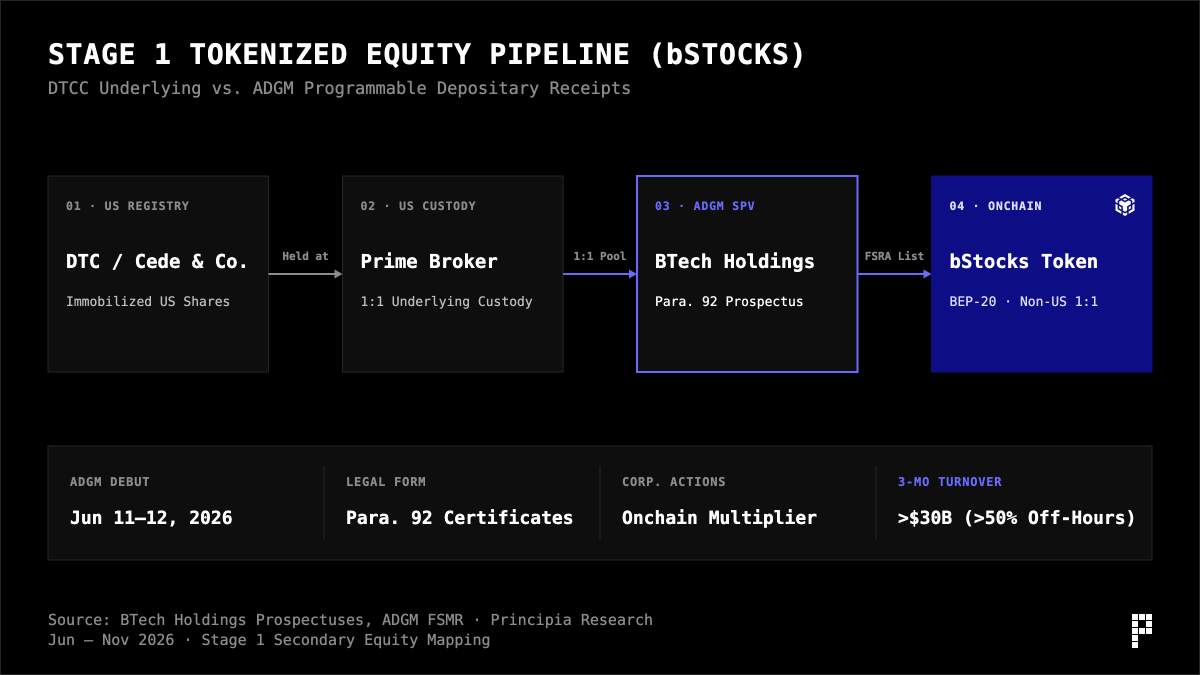
According to Principia, the prospectus makes one-to-one segregated custody, regular reconciliation and proof of reserves disclosure and contractual obligations for the issuer. Regulatory approval is not a guarantee that the reserves exist. A multiplier in the token contract accounts for stock splits and reinvested net cash dividends without requiring holders to exchange their tokens.
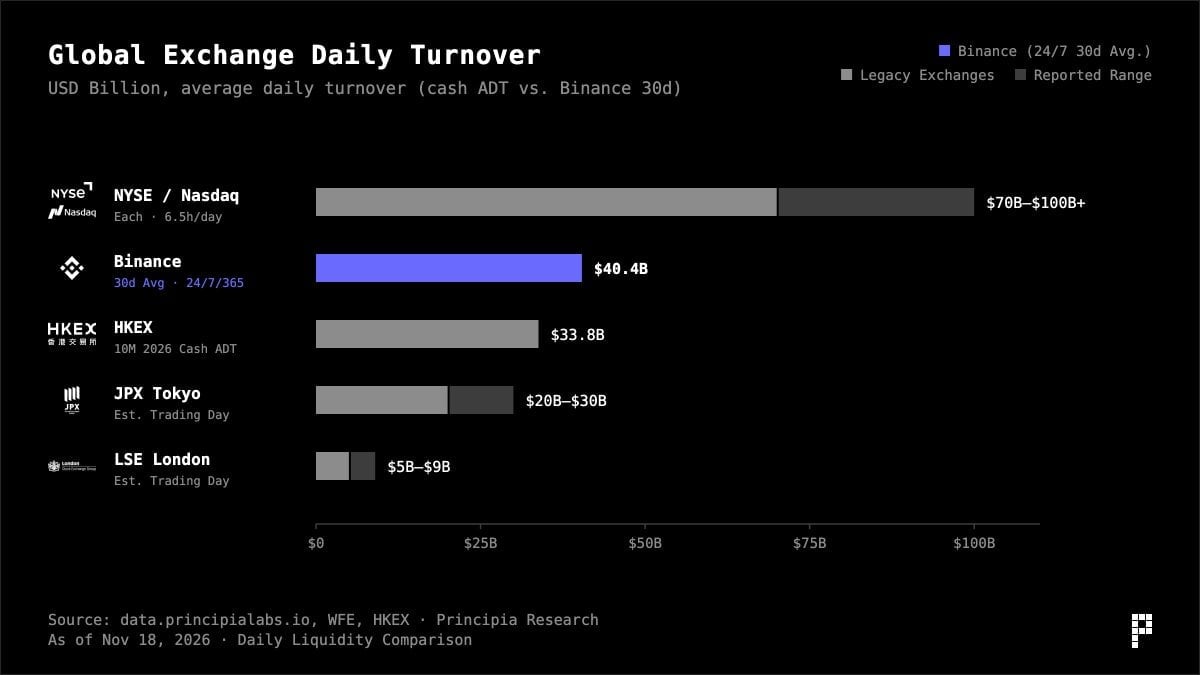
Bending Spoons illustrates the timing difference. The company listed on Nasdaq on July 1, 2026, at an offer price of $29. BTech subsequently obtained approval for a separate prospectus for BSPB, its Bending Spoons certificate. Buying BSPB gave investors exposure to a company that was already public; it did not give them an allocation in the Nasdaq offering. By early September, Principia reported more than $30 billion in cumulative bStocks turnover, over half of it outside US equity market hours. That figure measures trading, not capital raised by issuers.
Who trades, clears and issues the securities?
Binance.com’s move from its Cayman Islands structure into the ADGM regulatory framework was approved in December 2025 and took effect on January 5, 2026. It followed a $2 billion stablecoin investment in March 2025 by Abu Dhabi investment firm MGX, which acquired a minority stake and became Binance’s first external institutional shareholder. Binance co-CEO Richard Teng had led ADGM’s Financial Services Regulatory Authority (FSRA) from 2015 to 2021.
Principia identified distinct roles under the Irish parent, Binance Holdings (IE) Limited:
| Entity | Function in the Abu Dhabi market |
|---|---|
| Nest Exchange Limited | Operates the trading venue with recognized investment exchange and multilateral trading facility permissions. |
| Nest Clearing and Custody Limited | Serves as the recognized clearing house and central securities depository. |
| Nest Trading Limited | May deal as principal or agent and arrange investment transactions. It may not hold or control traditional client fiat money; its money-services permission is limited to recognized fiat-referenced tokens such as USDC. |
| BTech Holdings Limited and BTech Services Limited | BTech Holdings issues bStocks and files prospectuses. BTech Services handles minting and acts as disclosure agent. |
Principia interpreted the broker’s permissions as a basis for stablecoin subscriptions and same-day delivery versus payment, in which the securities and payment change hands together. UAE job postings offered a separate indication of Binance’s interest in the primary market: equity capital markets roles called for contacting prospective issuers and investment banks, conducting due diligence and preparing pricing models. Neither the permissions nor the postings establish that Binance has underwritten a native IPO.
What would change for an issuer?
In a native primary offering, the company would issue securities to subscribers and raise capital itself. Principia argued that this route could interest midsize companies, citing ADGM’s $20,000 prospectus review fee and $3,000 admission fee. The $23,000 total covers those two regulatory fees, not legal, audit or advisory costs.
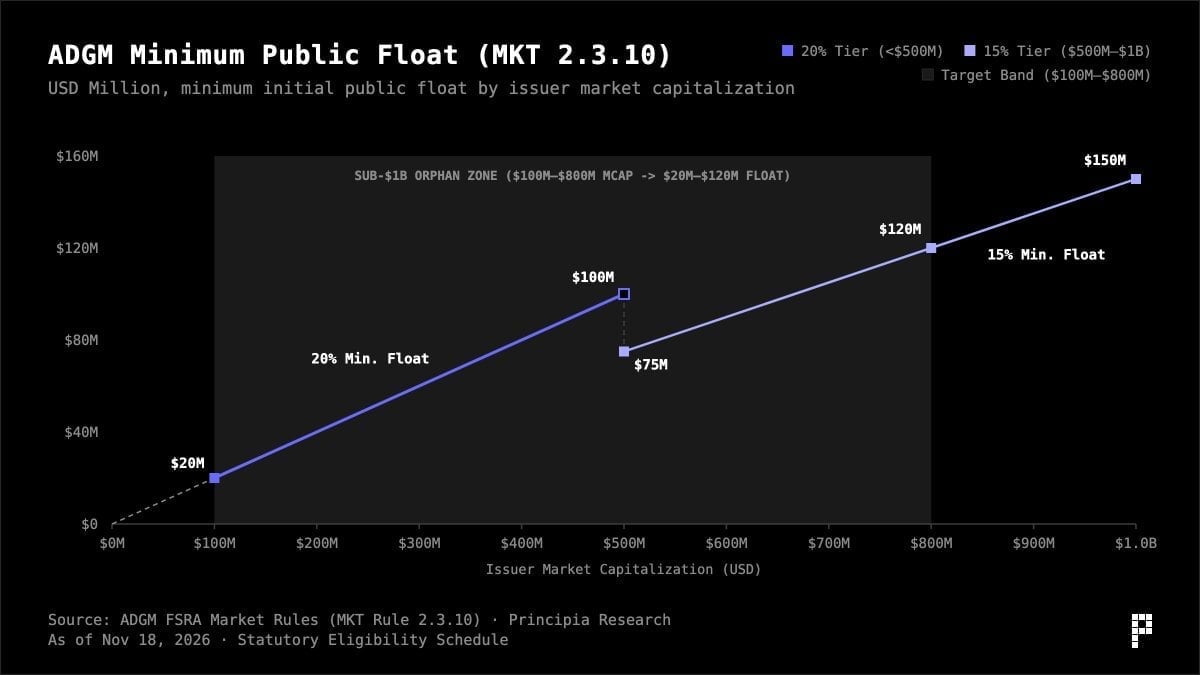
An issuer would also have to meet listing requirements. The profit test cited in the report requires at least $1 million in cumulative profits from continuing operations over three years and $500,000 in consolidated profit in the latest 12 months. An alternative test sets thresholds of $10 million in market capitalization, $3 million in net tangible assets and $1.5 million in pro forma working capital.
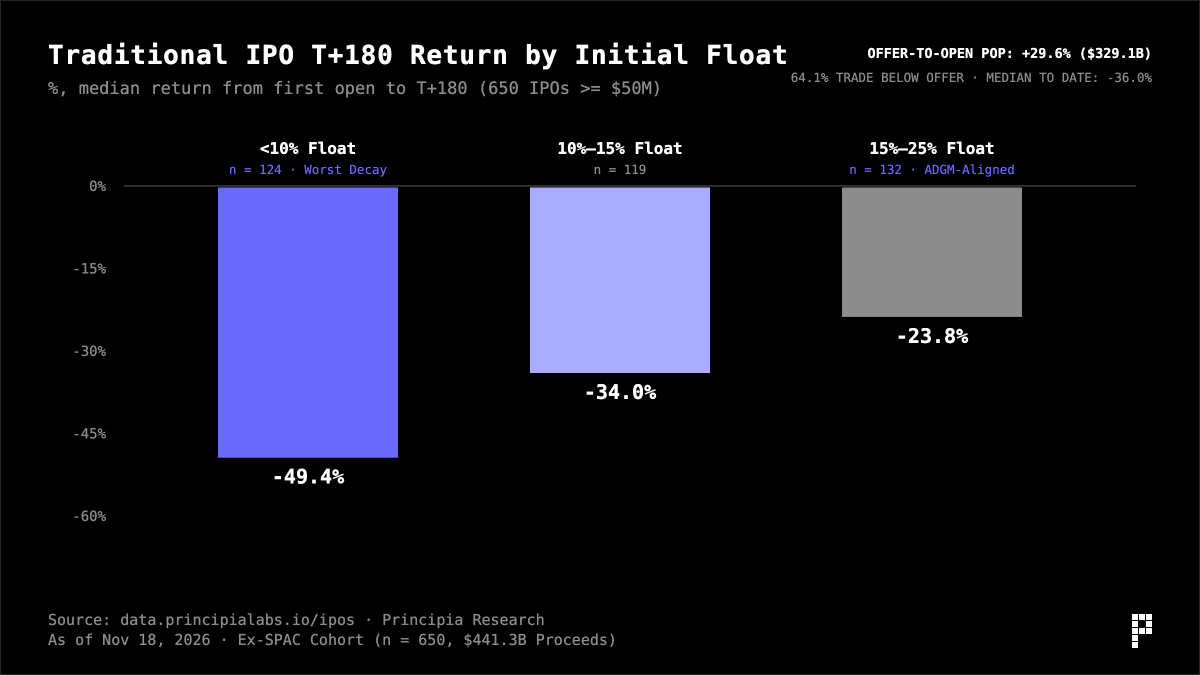
The public-float rules distinguish a securities offering from a token launch in another respect: not everything available to trade counts as publicly held. Principia cited minimum public holdings of 20% for issuers valued below $500 million and 15% for those valued from $500 million to $1 billion. Directors’ and related parties’ holdings, employee share-plan trusts, stakes of 5% or more and shares lent rather than sold to market makers do not count toward that float.
Principia’s November 28, 2026 report also considered whether a regulated Binance business in Abu Dhabi might itself list separately. That was the researchers’ scenario, not a company announcement. Teng had said Binance had ample cash flow and no near-term plan for an IPO to raise funds. The documented business was issuing and trading certificates backed by existing securities; raising new equity on-chain remained a separate prospect.