
Originally reported by Deep Tide TechFlow on November 6, 2026, at 22:09 UTC+8.
Ethereum core developers agreed to hold off on the Hoodi testnet fork while they examine compatibility risks from two proposed gas-pricing changes for the planned Glamsterdam upgrade. The distinction is between changing what an operation costs to execute and changing ETH’s token supply: this report concerns execution costs, not a supply change.
EIP-8037 and EIP-8038 aim to separate pricing for state creation and state access and adjust the gas charged for certain operations. The proposals are intended to better reflect the cost of maintaining Ethereum’s growing state, but their proposed rules could also invalidate assumptions built into existing software.
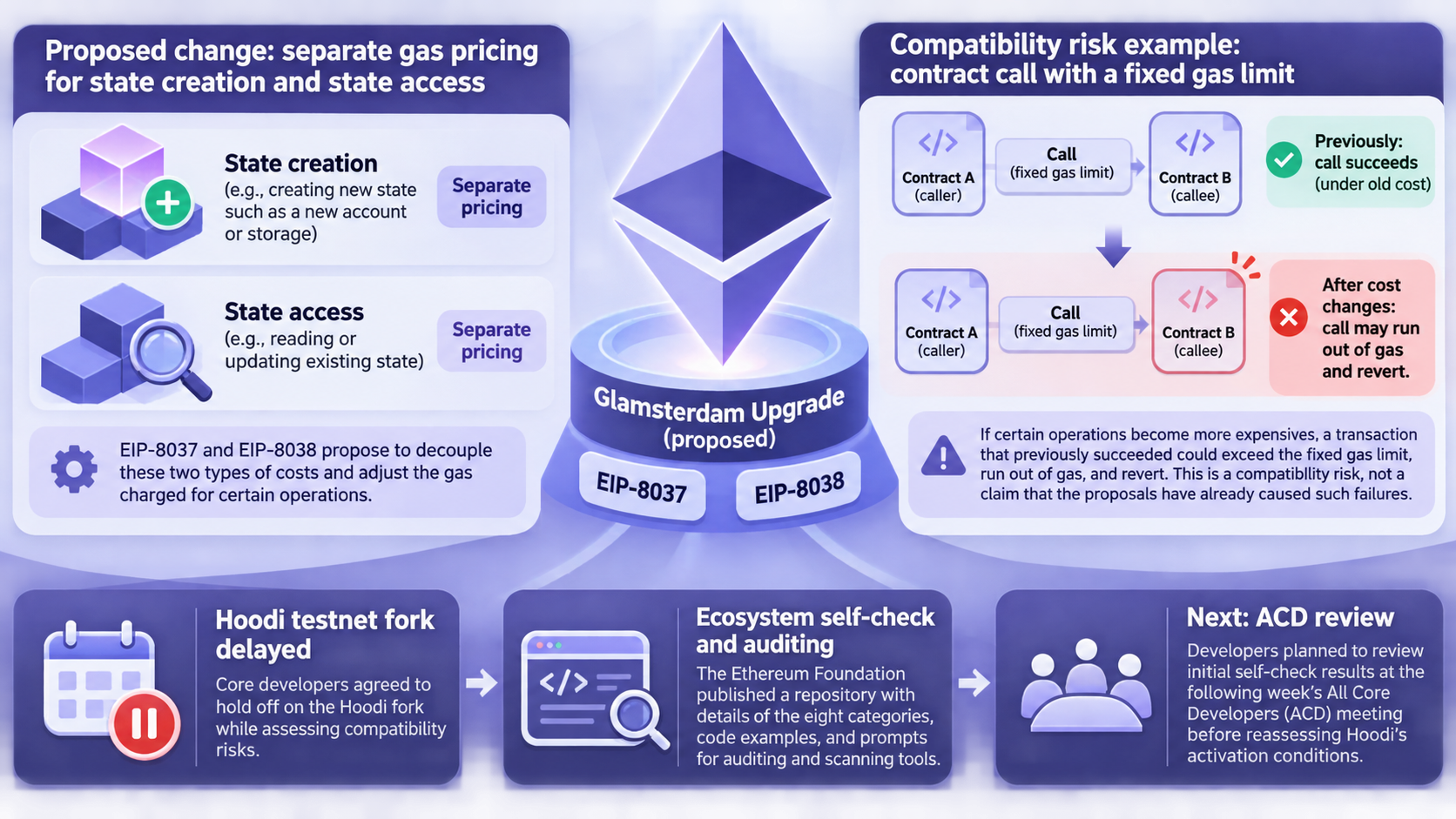
According to the report, security firm ChainSecurity identified eight categories of assumptions that may be affected. One example is a contract that sets a fixed gas limit for a call to another contract: if the call becomes more expensive, a transaction that previously succeeded could run out of gas and revert. The report also describes potential problems with exception-handling logic and proxy contracts that forward gas according to fixed proportions. These are compatibility risks, not a claim that the proposed rules have already caused those failures.
The report says the Ethereum Foundation published a repository with details of the eight categories, code examples and prompts for auditing and scanning tools. It also says developers planned to review initial self-check results at the following week’s All Core Developers meeting before reassessing Hoodi’s activation conditions. It did not give a revised fork date.
Source: techflowpost.com (originally published 2026-11-06 22:09 UTC+8)