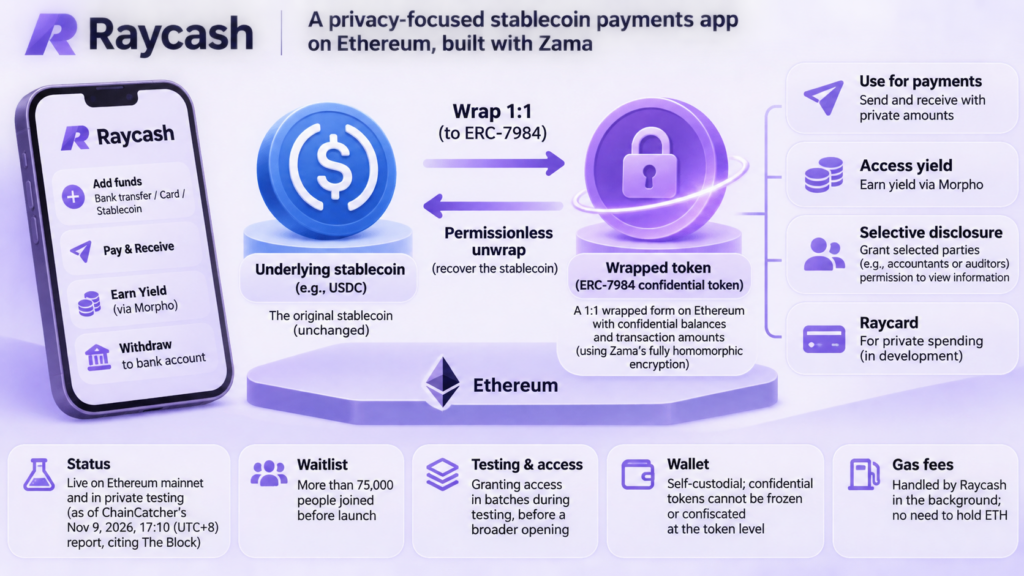
Raycash, a stablecoin payments startup spun out of privacy protocol Zama, had launched on Ethereum mainnet and entered private testing as of ChainCatcher’s November 9, 2026, 17:10 (UTC+8) report, which cited The Block. Raycash said more than 75,000 people had joined its waitlist before launch. It planned to grant access in batches during testing before opening the app more broadly.
How does a Raycash payment differ from holding the underlying stablecoin? Users can wrap a stablecoin 1:1 into a token using the ERC-7984 confidential token standard. Built on Zama’s protocol, Raycash uses fully homomorphic encryption to keep on-chain balances and transaction amounts private. The wrapped tokens can be used to send and receive payments or to access yield through Morpho; the underlying stablecoin can be recovered through permissionless unwrapping. These are features of the Raycash workflow, not a change to the underlying stablecoin itself.
The app initially supports USDC. Users can add funds by bank transfer, payment card or stablecoin, and withdraw to a bank account. Raycash handles Ethereum gas fees in the background, so users do not need to hold ETH to use the app.
Raycash says its wallet is self-custodial and that its confidential tokens cannot be frozen or confiscated at the token level. Users can grant selected parties, such as accountants or auditors, permission to view information. A Raycard for private spending was still in development at the time of the report.