Originally reported by Deep Tide TechFlow on November 10, 2026, at 20:53 (UTC+8). The proposal described below had not yet passed its final on-chain vote at that time.
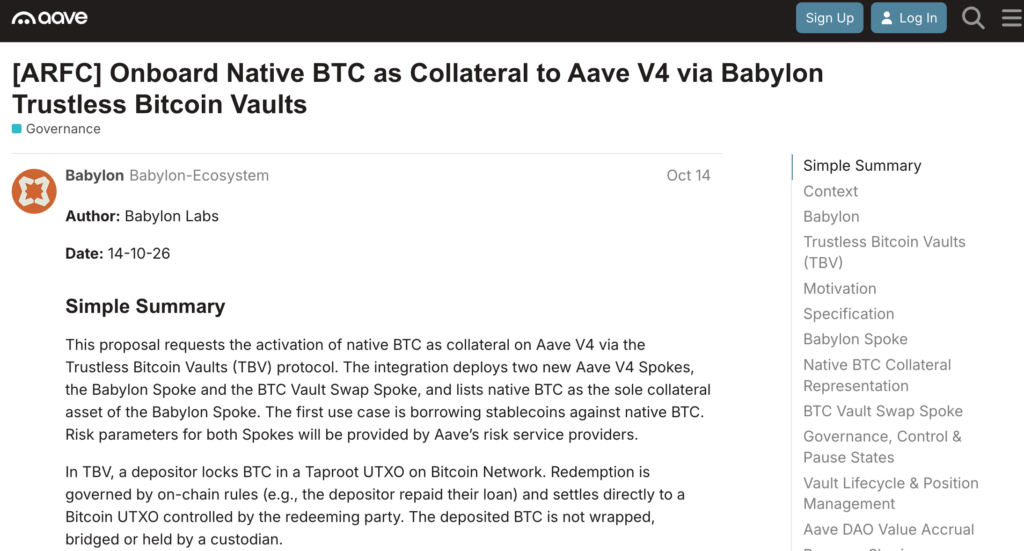
Aave DAO approved an ARFC-stage proposal on November 9 with 100% of votes in favor, according to Babylon. It would let users lock native BTC through Babylon’s Trustless Bitcoin Vaults (TBV) and borrow assets including USDT and USDC on Aave V4. The proposal still needed to advance to an AIP, Aave’s final on-chain execution vote. Its stated mainnet target was the end of 2026, with participation and capacity initially limited.
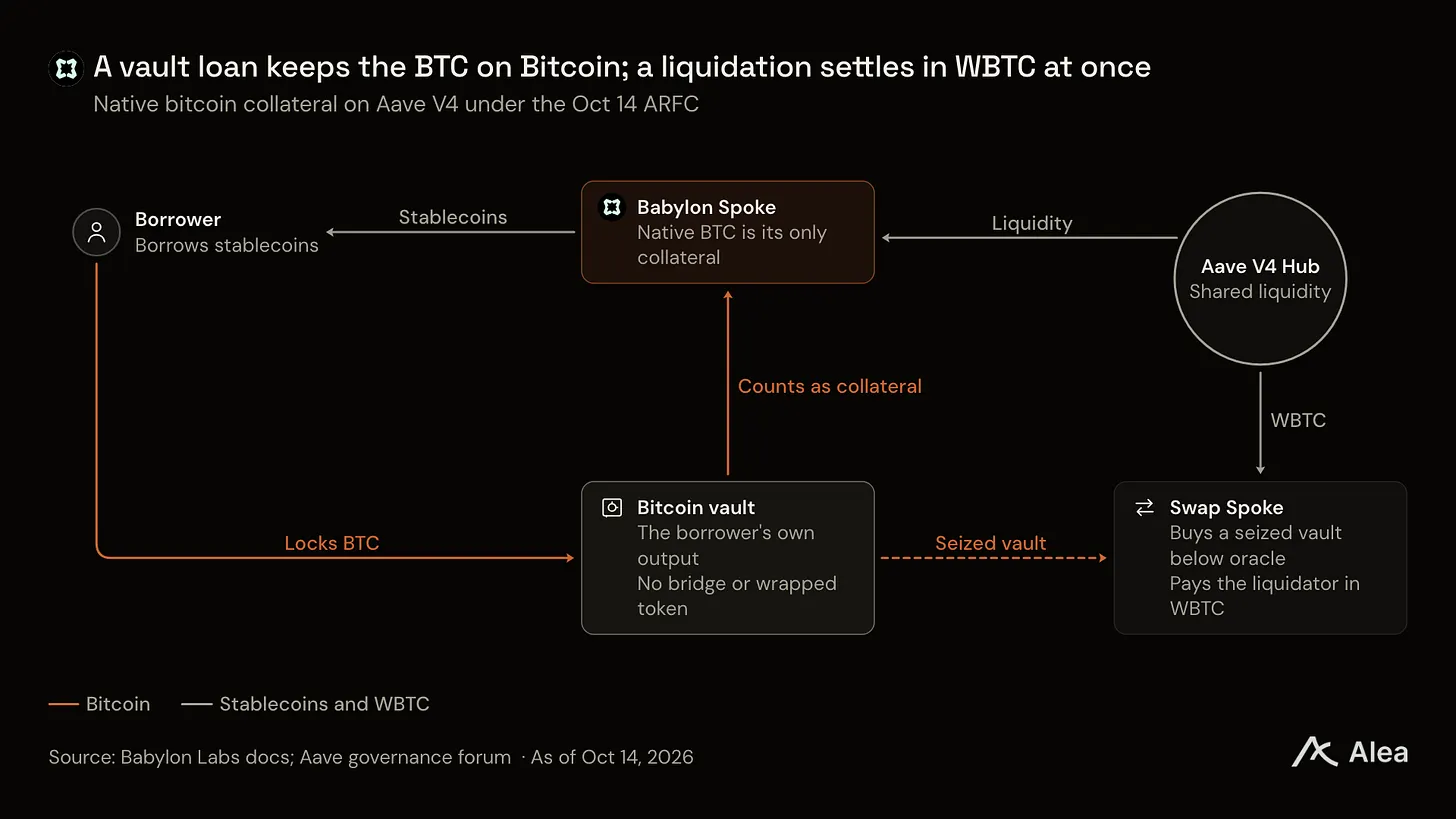
The comparison with Aave’s existing Bitcoin collateral is where the BTC remains and what represents it on Aave. Under the proposal, a borrower locks BTC in a Taproot vault on Bitcoin; a non-transferable accounting token on Ethereum, matching the amount locked, serves as the Aave V4 collateral record. The borrower retains control of their private keys rather than depositing BTC with a wrapped-token custodian. By contrast, wrapped assets such as WBTC and cbBTC depend on custody of their underlying BTC. Aave had also deployed an LBTC-specific market, but TechFlow describes this as its first proposal for unwrapped native BTC.
LlamaRisk proposed a 78% collateral factor and a maximum liquidation bonus of 5.55% for native BTC. PANews reported that the collateral factor and borrowing rates were comparable to those for WBTC and cbBTC in Aave V4’s core market. Alea Research relayed Babylon’s estimate of a 3%–5% annualized vault-borrowing cost, versus a cited 9%–16% range at centralized lenders; those are estimates and comparisons, not guaranteed rates.
What would AAVE and BABY receive?
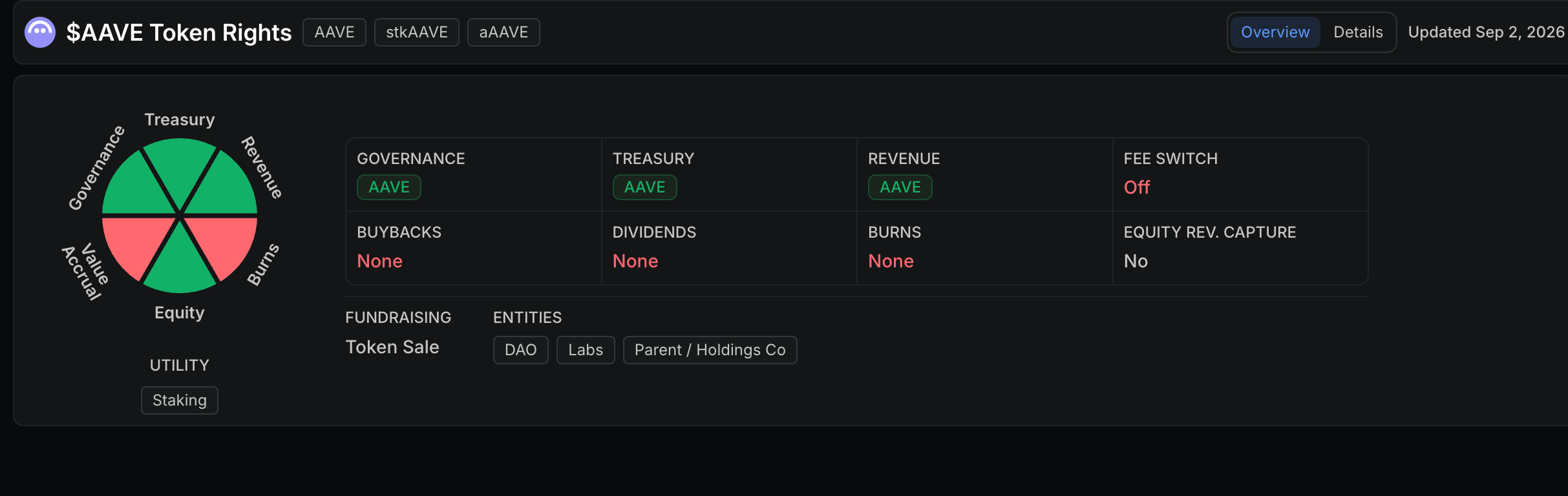
The proposed revenue split applies only to Aave’s liquidity fees from interest paid by borrowers in this market and to liquidation fees. Aave DAO would receive the first $500,000 of eligible annual revenue. For the portion from $500,000 to $2 million, the split would be 78% to Aave DAO, 18% to Babylon and 4% to token buybacks. For the portion above $6 million, it would be 61.5%, 31.5% and 7%, respectively, with intermediate tiers in between.
Buyback funds would purchase AAVE and BABY on the open market in an 85:15 ratio; the purchased tokens would be divided equally between Aave DAO and the Babylon Foundation. Alea Research estimated that at $10 million in annual eligible revenue, the split would be approximately $6.92 million for Aave DAO, $2.52 million for Babylon and $560,000 for buybacks—including about $84,000 spent on BABY. Alea characterized this as BABY’s first proposed value channel tied to borrower interest. For scale, TechFlow cited an Aave-approved reduction in AAVE’s annual buyback budget from $50 million to $30 million, while Alea estimated roughly 1.58 million new BABY tokens per day.
Capacity and the remaining wrapped-BTC dependency
The proposed initial borrowing limits were $8 million each for USDT and USDC, $2 million each for USDG and RLUSD, and $1 million for GHO: approximately $21 million in total. Native-BTC collateral would be capped at 300 BTC. Any later limit increase would require Aave DAO approval.
Native collateral would not eliminate wrapped assets from the entire process. Under the proposed liquidation mechanism, a liquidator would use WBTC to buy a seized vault, after which an arbitrageur could redeem its BTC on Bitcoin. The proposal would therefore remove reliance on a wrapped-BTC custodian at the collateral-deposit step, while retaining a WBTC dependency at liquidation.
The proposal also assigns emergency pause authority to a three-of-five multisignature group involving Aave Labs, LlamaRisk and Babylon. Pauses and resumptions would have no timelock; repayments and liquidations would also be blocked during a pause. The group would not have authority to transfer users’ BTC.
At the time of TechFlow’s report, Alea Research said Babylon planned to submit BABY tokenomics changes to governance by the end of November, aimed at directing more new issuance toward the vault business. Alea also noted that approximately 2,999 BTC staked under Gate custody were due to reach the end of their staking term around November 30; Babylon’s staked total could change if they were not renewed. Neither the tokenomics changes nor the Aave market’s launch was established by the ARFC vote.
Source: techflowpost.com (originally published 2026-11-10 20:53 UTC+8)