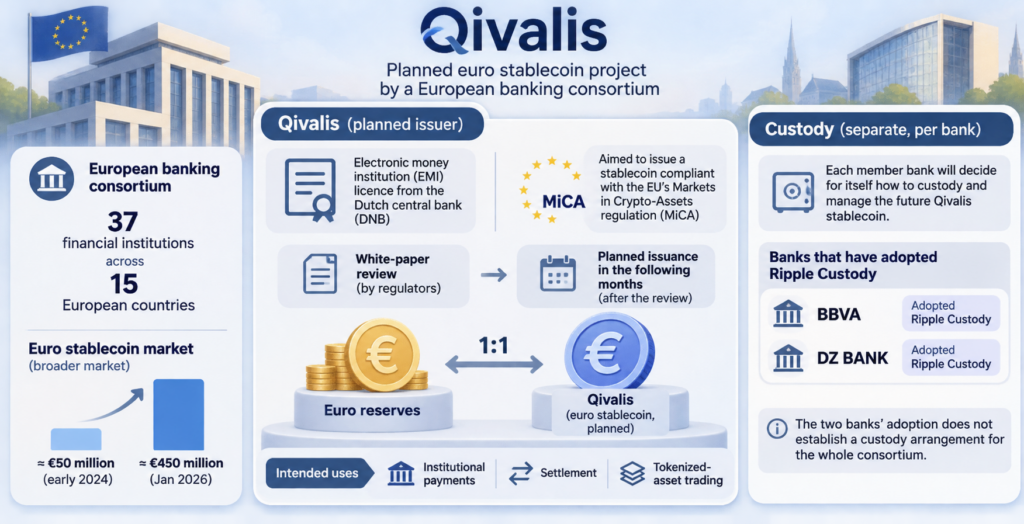
As reported on November 10, 2026, 37 financial institutions across 15 European countries had joined Qivalis, a euro stablecoin project established by a European banking consortium. The project aims to issue a stablecoin compliant with the EU’s Markets in Crypto-Assets regulation (MiCA).
Qivalis had received an electronic money institution licence from the Dutch central bank (DNB). It planned to issue a stablecoin backed by euro reserves at a 1:1 ratio in the following months, after regulators completed their review of its white paper. Its intended uses were institutional payments, settlement and tokenized-asset trading. The reported plan was not an announcement that the stablecoin had already been issued.
The distinction between the token and its custody matters here. According to Ripple, consortium members BBVA and DZ BANK had adopted its Ripple Custody digital-asset custody solution. Ripple also said each member bank would decide for itself how to custody and manage the future Qivalis stablecoin; the two banks’ adoption does not establish a custody arrangement for the whole consortium.
For market context, the report put the euro stablecoin market at approximately €50 million in early 2024 and €450 million in January 2026. Those figures describe the broader market, not Qivalis tokens in circulation.