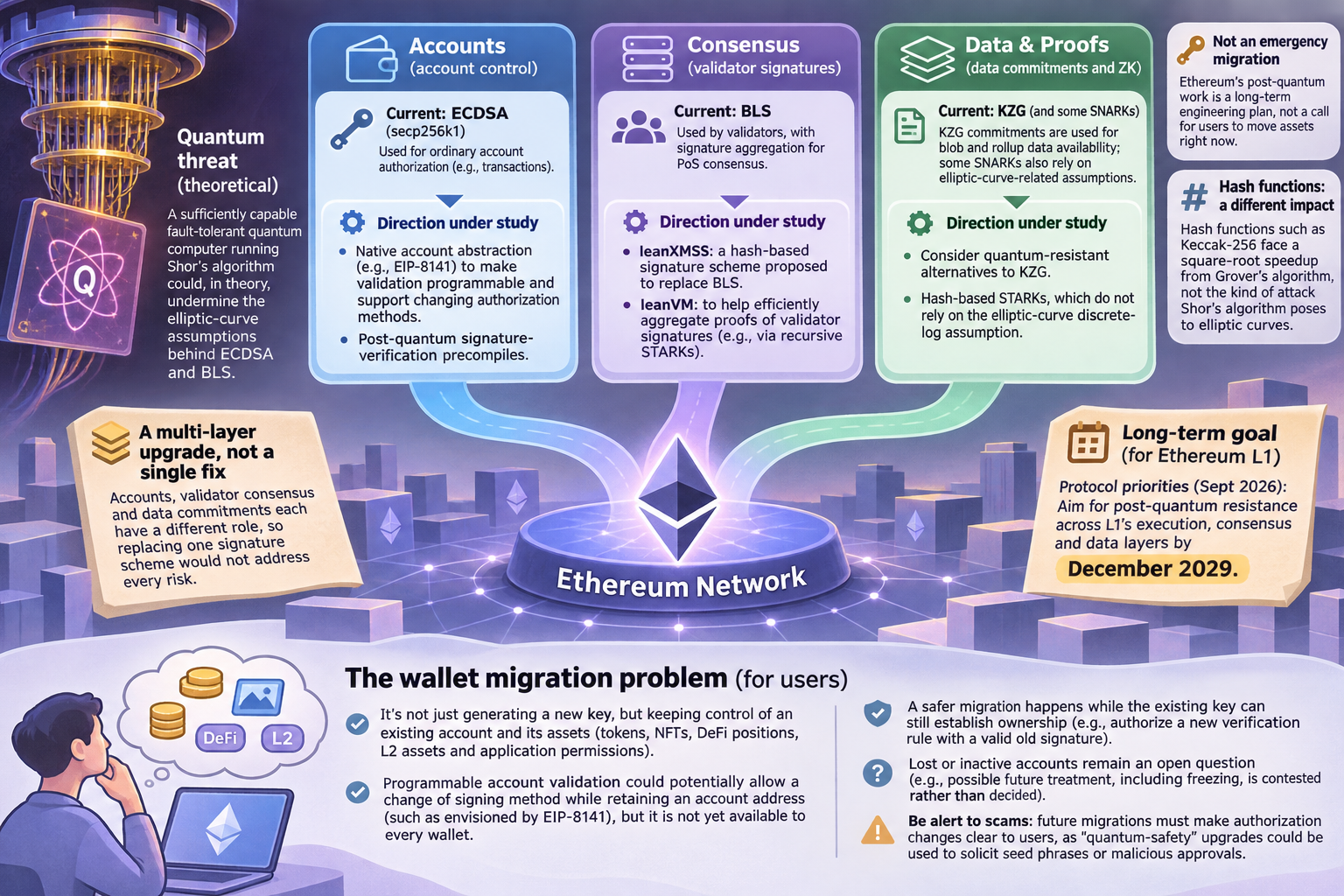
As reported on November 19, 2026, Ethereum’s post-quantum work was a long-term engineering plan, not an emergency wallet migration. The comparison is between the cryptography used for account control, validator consensus and data commitments: each has a different role, so replacing one signature scheme would not address every risk.
A sufficiently capable fault-tolerant quantum computer running Shor’s algorithm could, in theory, undermine the elliptic-curve assumptions behind ECDSA account signatures and BLS validator signatures. No quantum computer capable of breaking these systems had been demonstrated at the time of the report.
Why account exposure differs
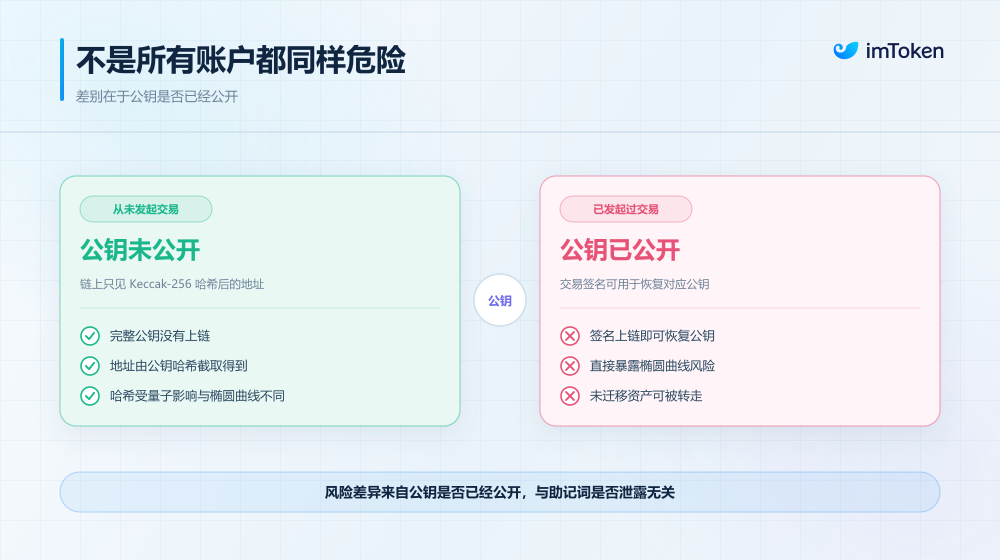
An ordinary Ethereum account address is derived from a hashed public key. If an account has never sent a transaction or otherwise disclosed a signature, its full public key may not be publicly available. Once it signs a public transaction, that signature can reveal the public key. In the hypothetical event that elliptic-curve cryptography becomes breakable, that distinction would matter: an attacker who derived a private key could forge signatures without obtaining a seed phrase.
Hash functions such as Keccak-256 face a different quantum-computing consideration. Grover’s algorithm offers a square-root speedup, rather than the kind of attack Shor’s algorithm poses to the elliptic-curve assumptions discussed above.
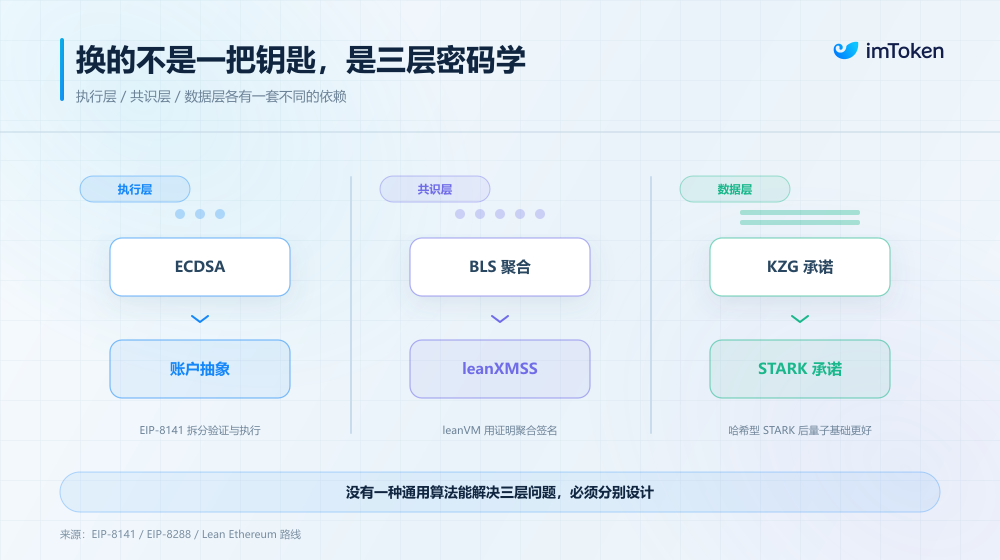
Three parts of the proposed upgrade
| Area | Current reliance described in the report | Direction under study |
|---|---|---|
| Accounts | ECDSA signatures tie ordinary account authorization to a secp256k1 key | Native account abstraction, including the proposed EIP-8141, could make validation programmable and support changing authorization methods. Post-quantum signature-verification precompiles are also under study. |
| Consensus | BLS lets Ethereum aggregate validator signatures | The Lean Ethereum approach proposes the hash-based leanXMSS signature scheme and leanVM to help aggregate proofs of validator signatures. |
| Data and proofs | KZG commitments support blob and rollup data availability; some SNARKs also rely on elliptic-curve-related assumptions | Quantum-resistant alternatives need consideration. Hash-based STARKs do not rely on the elliptic-curve discrete-log assumption. |
These are research and proposal directions, not completed replacements. Larger post-quantum signatures also create data and verification costs. The report describes EIP-8288 as a proposal to use recursive STARK aggregation to reduce that burden.
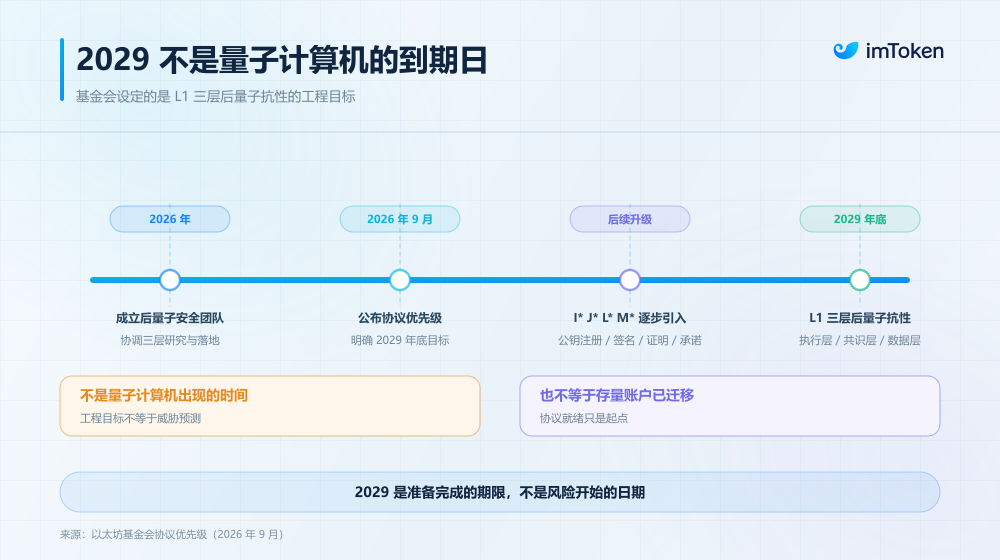
The report says Ethereum Foundation protocol priorities published in September 2026 set a goal of post-quantum resistance across Ethereum L1’s execution, consensus and data layers by December 2029. A goal is not a guarantee of deployment on that date; work affecting rollups and other applications would extend beyond L1.
The wallet migration problem
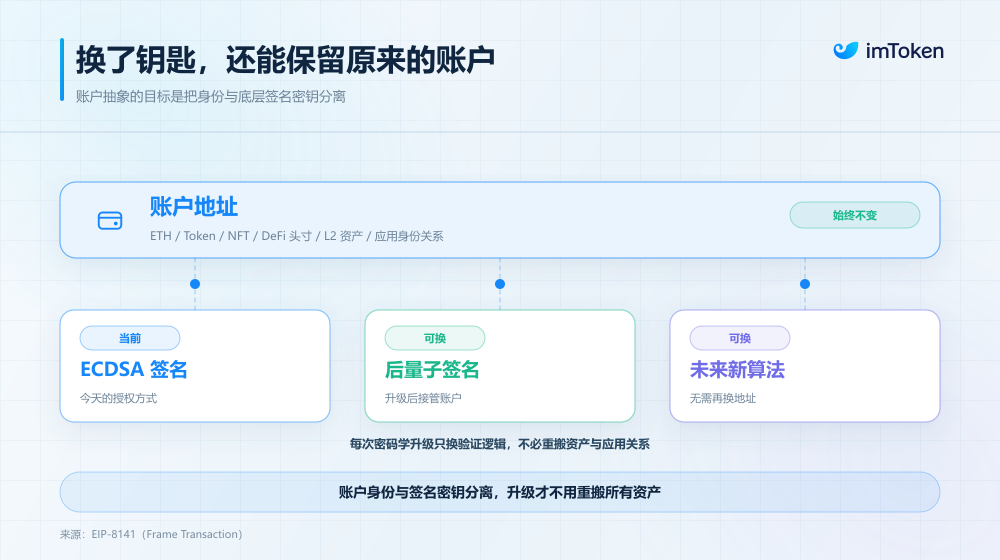
For users, the difficult question is not just how to generate a new key, but how to keep control of an existing account and its assets. Moving to a new address could also mean dealing with tokens, NFTs, DeFi positions, L2 assets and application permissions tied to the old one. Programmable account validation could potentially allow a change of signing method while retaining an account address, but the report does not present that as a capability already available to every wallet.
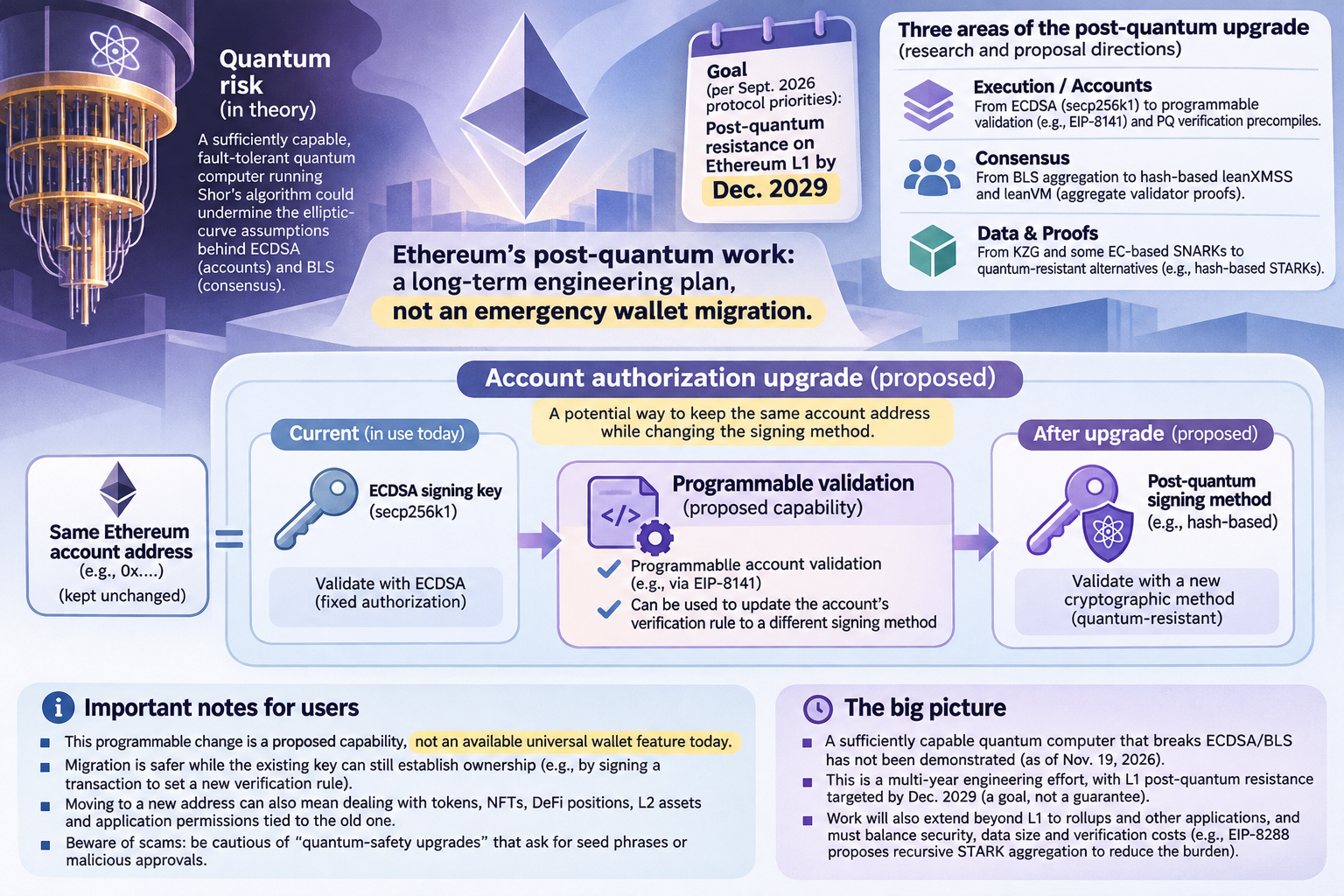
Migration would be safer while an existing key can still establish ownership: a user could authorize a new verification rule with a valid old signature. If an attacker could already forge that signature, it would no longer reliably distinguish the owner. Lost or inactive accounts pose a separate unresolved question; the report describes possible future treatment, including freezing, as contested rather than decided.
The practical conclusion as of November 19, 2026 was preparation, not a call to move assets immediately. Any eventual migration process would also need to make authorization changes clear to users, since purported “quantum-safety” upgrades could be used to solicit seed phrases or malicious approvals.