
What would change for an Ethereum contract deployed after EIP-8488, compared with one already on the network? As reported by Deep Tide TechFlow on November 9, 2026, the proposal was still a draft—not an activated Ethereum rule.
Under the proposed two-track design, contracts deployed before activation would continue using the existing gas-pricing rules. Newly deployed contracts would instead use a versioned V2 opcode set, with a version marker recorded when their bytecode is accepted. The draft also specifies that its new cross-contract call instruction would fail unless both caller and recipient are V2 contracts. That restriction concerns the proposed instruction; it does not establish that every form of interaction between old and new contracts would be impossible.
The V2 set would remove the GAS and GASLIMIT instructions, which the proposal describes as exposing execution-capacity information that developers might hard-code into applications. The distinction matters because changing gas prices directly for existing contracts could disrupt applications whose logic depends on those values. TechFlow cited Ethereum Foundation technical discussion of eight contract invariants at risk and described EIP-8037 and EIP-8038 as proposals, not changes already in force.
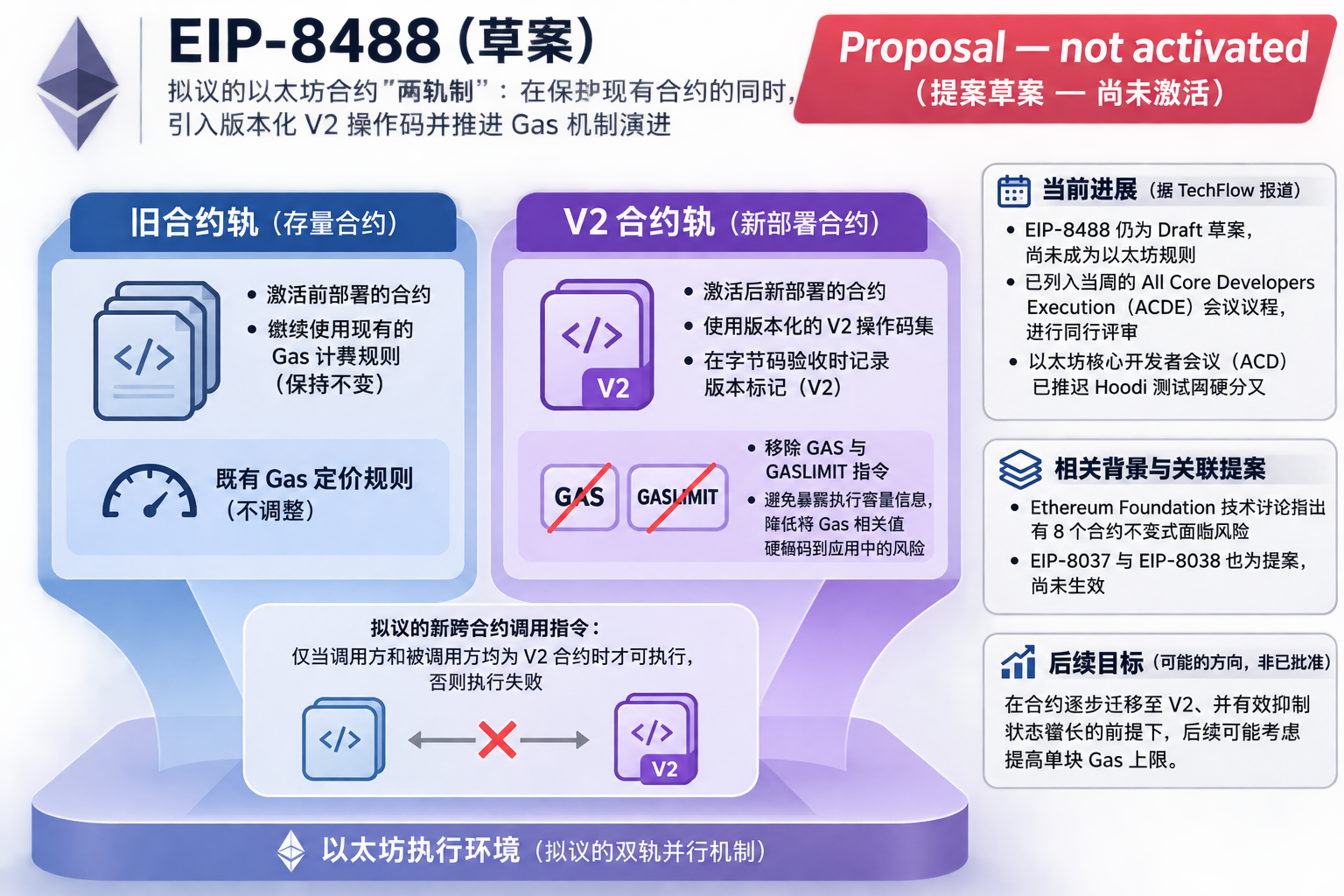
TechFlow reported that an Ethereum core developers’ meeting had deferred the Hoodi testnet hard fork. It also said EIP-8488 was on the agenda for peer review at that week’s All Core Developers Execution meeting. The article presented a possible later increase in the block gas limit as a goal contingent on migration toward V2 and effective restraint of state growth—not as an approved change or a measured outcome.
Source: techflowpost.com (originally published 2026-11-09 12:23 UTC+8)